

Are Influencers Ready For The Warfare Economy?
get ready with me for the civil war!

How should a person be in 2026? My social media feed is telling me that I should be prepared. Between the onslaught of fancams featuring Hudson and Connor of the rapidly developing Heated Rivalry fame, I am being served something different amoung my usual cocktail of TikTok Shop pull-up bars and ring lights: warfare consumerism.
“Do you have a gas mask?” one online merchant asks me through the screen as she tries on a double-filtered face mask. An electronic police siren blares in the background as someone simulates a stabbing motion with a sharp spike, and then a closed pair of scissors for good measure, into the mask, their piercing stabs bouncing off the visor with dramatic effect. Impervious, the whole ordeal suggests.
“I actually use this for woodworking so things don’t fall in my eyes,” the merchant surgically adds, to establish a plausible deniability for why a regular civilian would need such a mask. “It’s also good for emergencies, though,” she adds after testifying to the mask’s proficiency in filtering out paint fumes. Paint fumes. Oh, I’m sure. The mask’s intended purpose – for defense in the event of civil unrest, tear gassing, police brutality – is betrayed by its headline, which is SEO-maxxxed to the gawds, rendered to reach anyone within a few key strokes of the contemporary affairs of today. It reads: Reusable Anti-Fog Toxic Face Mask, Full Face Respirator with Filter, Gas Dust Poison Protection. Cute, does it come in a matte black finish?
I toggle to the reviews and see that over 2,800 units have already been sold, with the majority of the ratings scoring five stars. One reviewer remarks, “I bought 2 for a ‘just in case’ situation. Having them gives me peace of mind.”
Other ads are less subtle. I swipe and see another placement for a similar gas mask, but this time the influencer-merchant voice-over is forthcoming enough to use the words ‘civil war’ without fear of TikTok algorithmic suppression. Another swipe and my final influencer-merchant, who seems cast from a Bama Rush pledge, sits in her car, orating her sales pitch in a perfect ‘Problem → Solution’ narrative arc to her front-facing camera. Her ring light winks at me through the reflection of her irises:
“As we all know, the world is in chaos right now, and it’s only going to get worse. So if China, Russia, North Korea finally decide to attack the United States, they are going to take one big thing from us: the U.S. Power Grid. We are going to be getting hit with EMPs that will take out electricity, our internet, wifi for months… and you will not be able to use your phone as that will eventually die out.”
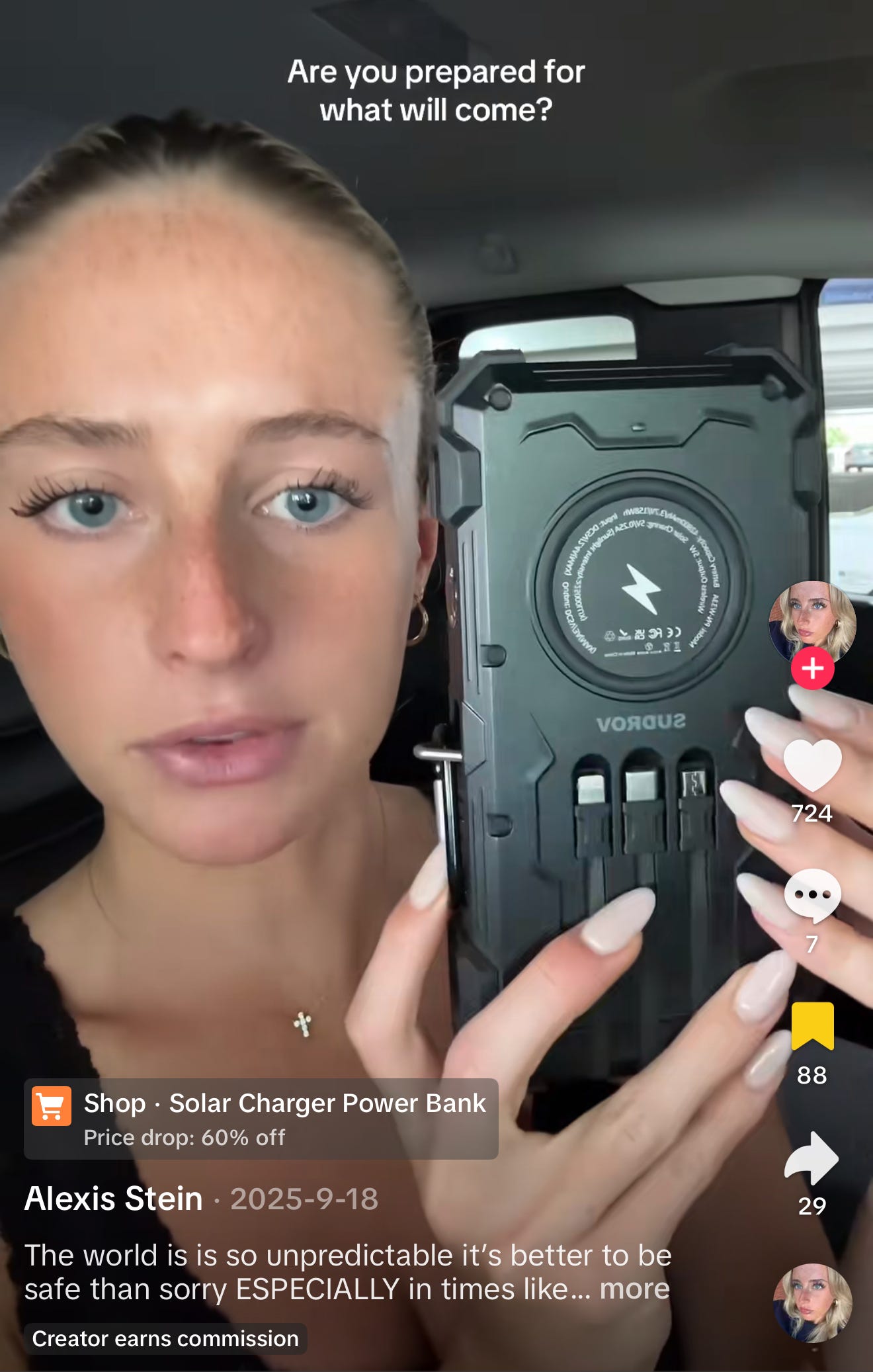
An illustrative setup of The Problem that cues images of the post-apocalyptic isolation of the latest 28 Days Later film. The saleswoman reaches somewhere out of frame and returns with The Solution: a black plastic brick that she claims is the ‘strongest solar-powered powerbank on the market,’ equipped with a compass, wireless charging, LED lights, and a USB-C adapter. It’s waterproof and shockproof, offering peace of mind at $39.98, already reduced by 60%, and available with four interest-free payments via Klarna. I try to think of its application practically, and envision myself charging the solar powerbank in the middle of a sunny park in Brooklyn, holding my phone to the sky like I’m taking a selfie so I can boot up to send a text to a group chat or post on Substack in the middle of a civil war. And yet, predatory as this influencer’s talk track is, she’s not completely wrong. What she is describing has happened before. An electricity blockade is effectively what the Israel Electric Corporation enacted when it cut power to Gaza’s only power plant, blocking cellphone activity and preventing The Palestine Red Crescent from maintaining contact with Gazans in need of care.
It’s only January. A TikTok influencer, who also promotes knock-off Ugg boots and baby pink polyester workout sets, telling me to Get Ready With Them For Civil War seems a bit ridiculous and fear-mongering vibes. But, as I look down the barrel of the remaining eleven months of the year, calculating America’s unknown odds, I’m unwilling to rule anything out. In the past twelve months, the news cycle has ventured from a Veep-like absurdity to absolute horror, recently peaking with the killing of Renee Good at the hands of a U.S. Immigration and Customs Enforcement (ICE) agent in Minneapolis. The rest of 2026 has cut open; the future thrashing and vulnerable like a curtain fighting against the wind. It seems as though just about anything can happen. And, suddenly, a troupe of influencers promoting warfare consumer goods makes complete sense. The influencer economy has shifted from promoting unattainable aspirations to zeroing in on our greatest fears. It’s always our insecurities that are the most bankable.
The U.S. government has also leveraged the influencer economy to service its defense agenda, most pointedly within the Immigration and Customs Enforcement agency’s recruitment efforts. The Department of Homeland Security has reported that ICE has increased its ‘manpower’ by 120% in just four months. It now counts more than double the number of ICE agents, from 10,000 to 22,000, since its budget increased after the passing of the One Big Beautiful Bill Act. Much of the recruitment campaign’s success is attributed to the agency’s online efforts, through advertisements placed on Spotify, Snapchat, and YouTube, as well as pre-roll ads on streamers like HBO Max and Hulu. As of early January, Spotify announced that it no longer allows ICE to run ads on its platform. The writer Brady Brickner-Wood details more in The New Yorker:
According to the internal document obtained by the Post, ICE hopes to target prospective hires through location-based marketing tactics like geofencing, a technology that allows the agency to send ads to the phones of people in specific locations, such as college campuses, gun and trade shows, military bases, and Nascar races. ICE has also allotted funds for right-wing influencers and streamers to promote hiring efforts, and flooded official Department of Homeland Security and ICE social-media feeds with memes. “Want to deport illegals with your absolute boys?” one graphic posted to X and Instagram reads; another image shows a classic car parked on a beach with the header “America After 100 Million Deportations.”
Humour me and imagine how the agenda’s impact could scale if ICE focused beyond micro-influencers and shifted to celebrity talent. Suppose ICE begins to invest in the production of media and entertainment to add ‘patriotic’ deportation narratives to films and video games.
We’ve already seen the memes from the White House Instagram page that have generated high engagement. Similar to the surge in popularity for Palantir merchandise, there is a brand to be made out of nationalism. The industry of defense and warfare “exists to sell paranoia and a promise to fix it.” There is a thin line between posting social media assets and being a government asset. If the bag is big enough, your fave, too, might be seated next to Erika Kirk at Turning Point USA.
Where there’s smoke, there’s McKinsey, the consulting superpower that advises the U.S. government across the Department of Defense, Immigration Services (ICE), and Health. Rachel Goldstein, a New York-based strategy analyst, pointed out that McKinsey has hired their first-ever creator economy advisor. This senior company leader will focus on “creator strategy, and organizing events for the creator community in the Bay Area and beyond.” For now, it appears that this senior advisor’s focus will be on helping Fortune 500 companies design their long-term influencer strategy, but it’s not hard to see how these insights can scale back to the government’s defense agenda, already a multi-million dollar client for the consulting firm.
Influencers create some of the most engaged content on the internet, earning a high degree of trust from their audience. When the mouths of influencers can be bought by political lobbyists, what happens to the feeds we watch every day? Maggie Severns expands on the influencer profile that has already received funding from political groups and how these tactics skirt disclosure agreements in The Wall Street Journal:
A camera-ready pack of Gen-Z social-media natives—many of whom were too young to vote when Trump announced his first run for office—are reaping the rewards. They don’t work for traditional news outlets and are thus unshackled from newsroom ethics rules, such as the typical ban on accepting gifts worth more than $25. They don’t have to follow the disclosure laws that apply to big-money super PACs or lobbyists. And they have large followings eager to hear pro-Trump views, a gold mine for those looking to sway both Washington and the public.
I wonder how long until we start seeing affiliate links and ShopMy lists stacked with civil war survival kits. Similar to beauty products and apparel, where influencers must disclose paid partnerships through the hashtags #ad or #paid, I believe that political content should be equipped with the appropriate disclosures if funding or incentives are provided. If I’m being generous, maybe it’s not a bad thing that influencers are being encouraged to discuss geopolitical issues. As the thought leaders for the new generation and the stars on the most-watched platforms today, there is an argument that this investment can bring attention and relevancy to politics, igniting interest beyond an influencer’s contracted talking points for supplemental research. But that’s just the optimist in me, proof that my New Year’s resolution of being ‘more positive’ has been kept. The 2025 cynic that still lives somewhere in me believes that this is something to pay attention to. Prepared. This year, that’s just how a person should be.
LOOSEY is a newsletter about culture, art, technology, and the way we live. If this is something you like, consider subscribing and sharing.
It's a bleak torrid consumerism that hedges it's bets on things that haven't occurred yet. It all feels like a disgusting kind of LARP where the people who use TikTok shop think that a power bank will help them through a civil war will ironically be the least effected by such a thing. It's a disconnect from the material knowledge of these situations and the material's needed to "survive" them. Whatever happens at least it'll be interesting in hindsight. Wonderful writing.
I was genuinely thinking about this a few nights ago!! What will an influencer's role be in the face of war and societal collapse? I can already see the hauls people will make online about the kind of gas masks, power banks, first aid, they managed to buy on TikTok shop. It's comical and saddening.