

Empty Ambition
industry season four, silicon valley, and ‘highly agentic’ people


In the end, the game was not so hard to work out. Each player took turns constructing their own version of the future, and the vision that was the most irrefutable won. Not because it was the most honest, or the most commonly understood, or the most accurate, but because it was simply the most convincing. The most enduring. Painting an indestructible future was the game, and those who played pointed in opposite directions, expressively pushing a narrative, a mandate, and a promise that was predicated on the deflation and devaluation of the other. Crooked fingers punctured holes in some futures to point towards another. Such is the game of capital markets, short selling, and new ventures, and such is the game that Harper Stern is skilled at winning.
Within the first few moments of the season four finale of HBO’s Industry, we find Harper at the end of another hard-won game. She comes to us as an established short seller, having spent the entirety of the season constructing a narrative to devalue Tender – a nefarious, government-backed payments provider with its sights set on becoming a multinational bank.
Even though her prediction scores her multi-million dollar earnings, her prediction isn’t entirely based on facts. Though Tender’s balance sheet is revealed to be a fabrication, the timing of Harper’s success feels like a fluke. She committed to the short long before uncovering proof of duplicitous audits, and instead, she has relied on her usual toolkit: government lobbying, witness tampering, insider trading (Harper’s favourite!), and planting stories in the media. She spun the right story, rolled the dice, and won big. What started as a hunch, an idea – mere fiction! – turned into fact.
But the philosophy of betting on a business to fail, on exploiting the holes in its validity, is a cypher for the series. The characters of Industry are all constructions, desperate tryers who use fabrications to signal their potential, while others, and the market, place bets on them. Money is made that way. Paying for a promise. The show asks: can we invest in the potential of people, trade and short them like stocks, even if their parts are false?
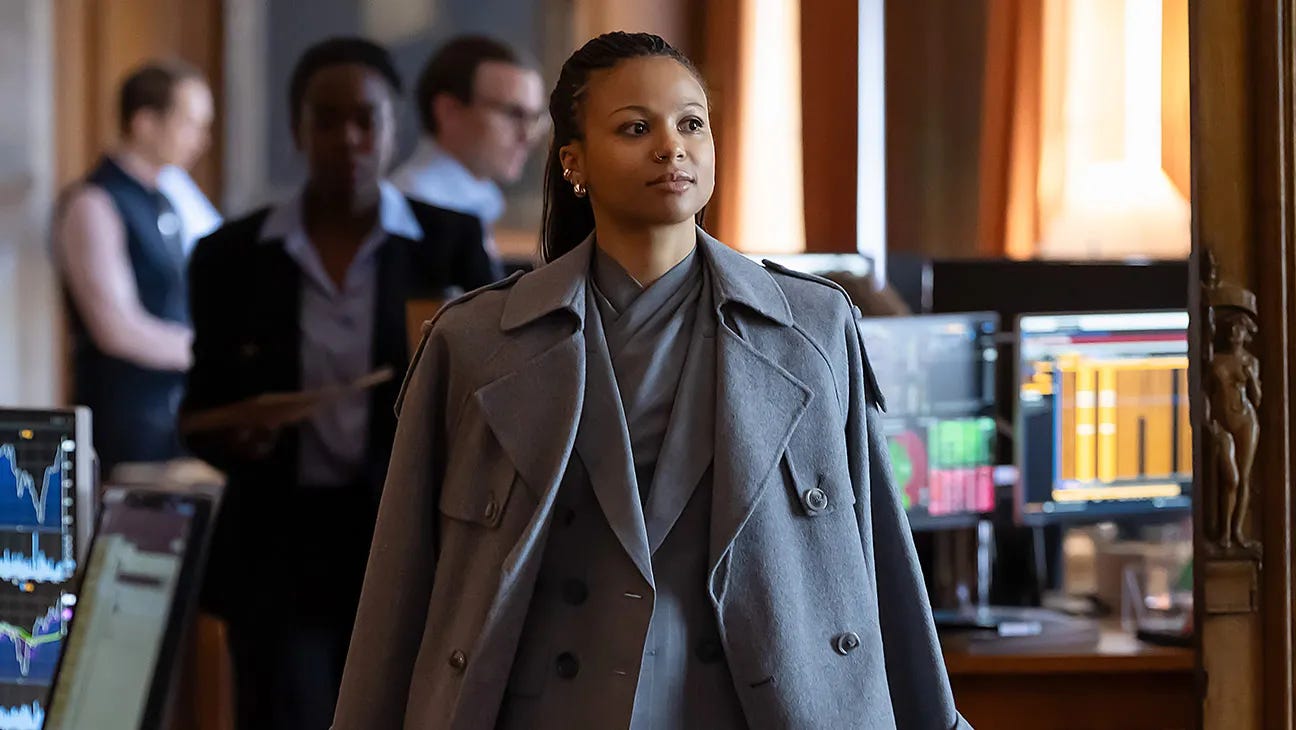
From the first season, we catch wind of Harper’s own fictions: the phony university transcript she uses to score a job at Pierpont, the fictionalized British investment bank where much of the show’s earlier seasons take place; her corporate persona that she learns to harden then soften depending on the audience or deal; her reptilian ability to shed whoever is no longer useful to her – who poses the biggest threat to her vision of the future. Over the seasons, we witness the degradation of the entire cast as they descend into shells to play the game, a hardening that is most apparent in Harper Stern, played by Myha’la, and Yasmin Kara-Hanani, played by Marisa Abela. While many of the characters of Industry fade away across seasons like America’s Next Top Model credit portraits, the two women remain, outlasting their counterparts through a mix of deception, self-destruction, and perseverance. They want to win the most, even if it often looks like they are losing.
When the show is operating at its best, Harper’s coldness feels explained — a trauma response to abandonment and an exterior molded from imposter syndrome. This all folds into her insatiable desire to win, whether it be executing a big trade before the stock market closes or hoodwinking investors on a short. But there are times when her characterization feels shallow. We never really get to witness the fruits of Harper’s labour. This season, we see that her wealth has upgraded her wardrobe with iconic caped suit skirts and black ostrich-feathered cocktail dresses. But we never get to see her really luxuriate or take pleasure in the riches she accrues. I don’t even know if she has hobbies. I’m unclear as to why she is playing so hard, and, a few episodes into the latest season, I want more interiority to understand what is guiding her aggressive propulsion. As the rest of the series became more colourful, with complicated new villains like Whitney Halberstram and Henry Muck, continued expansion into politics, and cross-continental investigations, it was odd to see Harper, the show’s protagonist, feel so secondary. At first glance, her ambition felt empty. But, at the season’s completion, I began to understand that perhaps empty ambition is the point.
How many people have you worked with for whom work is simply their whole life? Where their focus was simply on the next win, rather than what the win provided them? How many of those people are us? As I zoom out to compare Harper’s burned-out single-mindedness with real-life figures, her hollowness feels common. And in a well-dramatized season in which the showrunners have pushed the stakes fiercely across all metrics of storytelling – my favourite of the series so far – Harper’s empty ambition might be a characterization that is closer to fact than fiction, beyond anything else in the season.
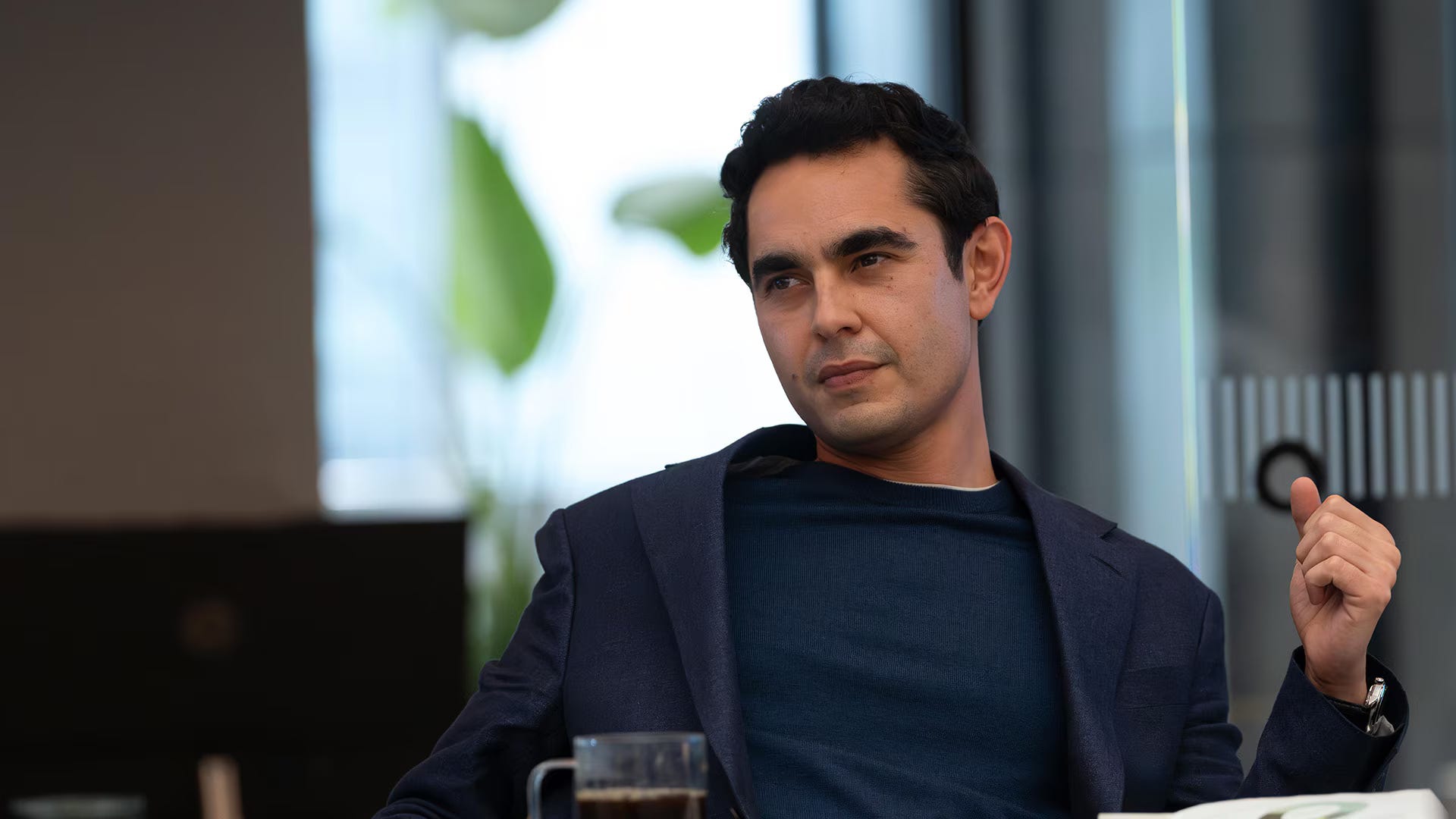
When I interviewed the creators of Industry, Mickey Down and Konrad Kay, in 2024, I left the conversation believing that the next season would move to New York to focus on the tech industry. I was wrong about the location, but, as it turns out, I was warm about the industry. Over 8,000 kilometres from London, across the sapphire waves of the Atlantic and the gridded vineyards of Napa, lies Silicon Valley. Named in the early 1970s for its dense concentration of silicon chip manufacturers that led to the technological booms of the global hardware and software industries, it’s also a wry metaphor for the area’s game of betting on plastic promises. The writer Sam Kriss explores these fabrications and those who play the game in an essay for Harper’s (lol) called ‘Child’s Play.’
Kriss visits San Francisco to meet with a handful of startup founders. One of his subjects is Roy Lee, the 23-year-old founder of Cluely, which, at the time of Kriss’s reporting, was an ‘undetectable’ AI assistant that promises to give you real-time responses to questions, whether you’re in a meeting or on a date. It does this in over twelve languages. It has raised over $20 million as of June 2025, even though reports indicate that Roy has earned over $120 million during his short career. The only issue, as Kriss discovers, is that it doesn’t really work. When Kriss suggested that he use Cluely to help him interview Lee, the machine spat out the same circular loop of conversations:
I started to worry that I would be trapped in this conversation forever, constantly repeating the machine’s words back to it as it pretended to be me. I told Roy that I wasn’t sure this was particularly useful. This seemed to confuse him. He asked, “I mean, what would you have wanted it to say?”
I found it strange that Roy couldn’t see the glaring contradiction in his own project. Here was someone who reacted very violently to anyone who tried to tell him what to do. At the same time, his grand contribution to the world was a piece of software that told people what to do.
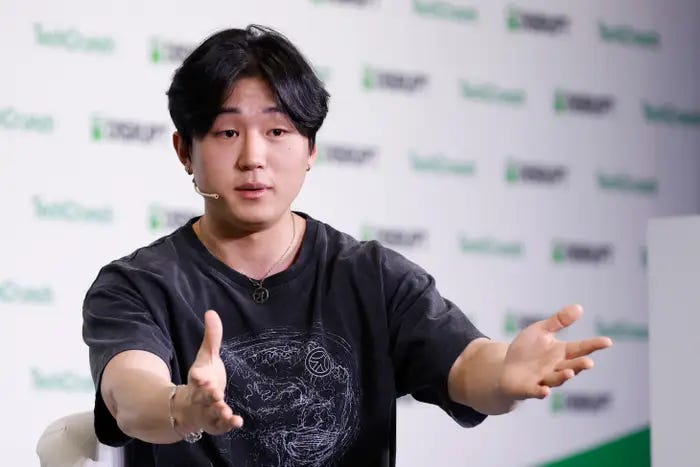
It’s hard to finish the essay and not feel pity for Lee. Kriss’s characterizations of him aren’t unkind, but they’re not generous either. Here is a founder who, like Harper, sleeps at his office, doesn’t have much of a social life, and has seemingly put everything into a business in which its operations are… unclear. Lee says that 80% of the people who meet him don’t like him, and his social interactions, as captured in the essay, appear mechanical and hollow. Kriss describes this Silicon Valley personality trait as ‘agentic.’
An AI might be able to code faster than you, but there is one advantage that humans still have. It’s called agency, or being highly agentic. The highly agentic are people who just do things. They don’t timidly wait for permission or consensus; they drive like bulldozers through whatever’s in their way. When they see something that could be changed in the world, they don’t write a lengthy critique—they change it.
There is something human about using your free will. About taking action. It’s a quality that Harper, Yasmin, Whitney, and Roy Lee all have. You probably have it, too. But what good is will when it’s not connected to purpose? What good is ambition if its genesis is not authentic? When that will is put behind something fabricated, the output isn’t human at all – it’s robotic. These ‘agentic’ people have been able to will something into existence from nothing. Or at least, something worth a pretty penny. There is perhaps nothing more human than creation, but why is it that in cases like these, it feels the opposite?
I am fascinated by stories of ambition. People who had the will to bet on something big that no one else could see. I watch old interviews of Lady Gaga, how she knew she was going to be famous before anyone knew her name, and draw a line to Timothée Chalamet’s speech at last year’s SAG awards in which he declared he was in pursuit of greatness. Ambition with purpose is better than mere agency because there’s a destination in sight. The pursuit of endless wins signifies a lack, and lack can only produce more lack. Harper and the rest of her peers have the deadly mix of high confidence and low self-worth, a treacherous bind that keeps them playing the game, adjusting the score no matter how many rounds they win. How many times have you gotten something you’ve wanted, only to be thinking about what’s next shortly after? Ambition is great, but anything that pursues exponential growth at all costs is something else; it’s cancer.
In an earlier season of Industry, Harper has a conversation with another peer on the trading floor, one that further reveals the tenor of her empty ambition. Her peer says:
“Part of me always feels like I deserve the world. Part of me always feels kind of –”
“Less than?” Harper answers. She rolls the dice again, remaining in the game. At least for one final season. Lucky us.
Thank you, HBO, for the advanced screeners of this season of Industry, and congratulations to Mickey and Konrad on the best season yet. The first sentence of this essay is from Cathy Horyn’s review of the most recent Prada show in The Cut. I loved it so much that I had to use it for LOOSEY.
LOOSEY is a newsletter about culture, art, technology, and the way we live. If this is something you like, consider subscribing and sharing.
obsessed with this. The tying of Eric and the mirroring of his emptiness- the way we see that the wins don't even matter to him, the money is meaningless, everything is sort of the same flavor of bland- with Harper's in the finale, the moment where she sits on the bed and is like... now what? Her first thought is to call Eric, thematically tying them together. the money is the money is the money but these characters don't even care about it, it's the pursuit of it that drives them and the hollow victories don't mean anything bc they can't escape the loop of the pursuit!!!! praying that Harper is slowly changing but last night's moment of "are you done?" felt so poignant.
This was a really refreshing and validating read because I wrote a review of Marty Supreme a few weeks ago that touched on very similar themes (also calling out Timmy’s ambition and the parallels with his character). Ambition is the necessary executor of purpose or self-belief, without which our passions are toothless, no matter how strong; but ambition without purpose is reckless, hollow, and ultimately self-destructive. It’s a delicate balance.
Industry has been on my list for a while, this might be what I needed to put me over the edge!