

Vacationland
vacation homogeneity and optimization culture, widows bay, loewe and j. crew, and sunscreen, too

When all else fails, and your flight gets delayed, and your Airbnb catfishes you, and you can’t shake the oppressive quake of jetlag and your air conditioning breaks in the midst of a heatwave, you can always count on the bottles of sunscreen to tell you how to feel. There’s the yolky yellow and white blob of Supergoop, bright and weightless, with names like ‘Unseen’ and ‘Play’ that suggest a nonchalant, ‘go with the flow’ approach to holiay. It’s casual and easy, like the vacationer who says ‘yes’ to everything, with it miraculously all working out. Then there’s Vacation, with packaging that looks like it was shorn from Sabrina Carpenter’s ‘Espresso’ music video. Rather than leading with SPF protection or clinical dermatology, the brand heralds its scent, of all things, as its distinguishing property. The brand’s sensory-over-substance persona promises ‘the world’s best-smelling sunscreen’ commercialized through bottles that feature the claw of a red-nailed white woman gently fondling a creamy dollop of its ‘whip’ and a lubey oil marketed as ‘chardonnay.’ This vacation is charming, playful, and poised to attract a weekend lover from an upright beach chair. And for those more interested in technical precision, let’s say performance as positioning and posture, there is Hard Sun, a newer brand whose brutalist, no-frills aesthetic merges the direct ingredient registry of The Ordinary with the cool-kid, lost youth visuals of a Wolfgang Tillmans editorial. It’s for those who plan their vacation minute by minute, right down to the self-timer, but you’d never know it from how their grid looks.
When exploring what the vacation economy has become, sunscreen is the best place to start. It’s as much about efficacy as it is about aesthetics, and is seemingly more interested in the performance of leisure than its embodiment. We are no better. We are ‘out-of-office’ only to continue optimizing. All aboard. Welcome to travel and leisure in 2026, or what I like to call: Vacationland.
Despite the collective expectation that our holiday travel will relax us, we have become fixated with the mechanical optimization of our vacations. We return from our trips claiming to our colleagues and friends that we need a ‘vacation from our vacation,’ and it’s no surprise. Modern-day leisure requires labour: the booking ahead, the hustling of the trip, and its participants ‘out of the group chat,’ the purchasing, packing, and unpacking of vacation garments, and the setup and theatre of the perfect Instagram post. Even relaxation is exhausting.
For those of us fortunate enough to go on vacation, the pressure to maximize said vacation is weighted by a burden to spend our ‘free’ time wisely. As global inflation rises, up across nearly all G20 countries, so does the cost of airfare. In the U.S., airfare has increased by 7.7% year over year, further reducing how many people can travel and for how long. Suddenly, not only is there a need to book in advance to capitalize on lower costs, but there is a greater pressure to spend the time effectively once on vacation. No more dillydallying. Adios wanderlust! Every minute you spend on vacation is now exponentially less affordable than the last.
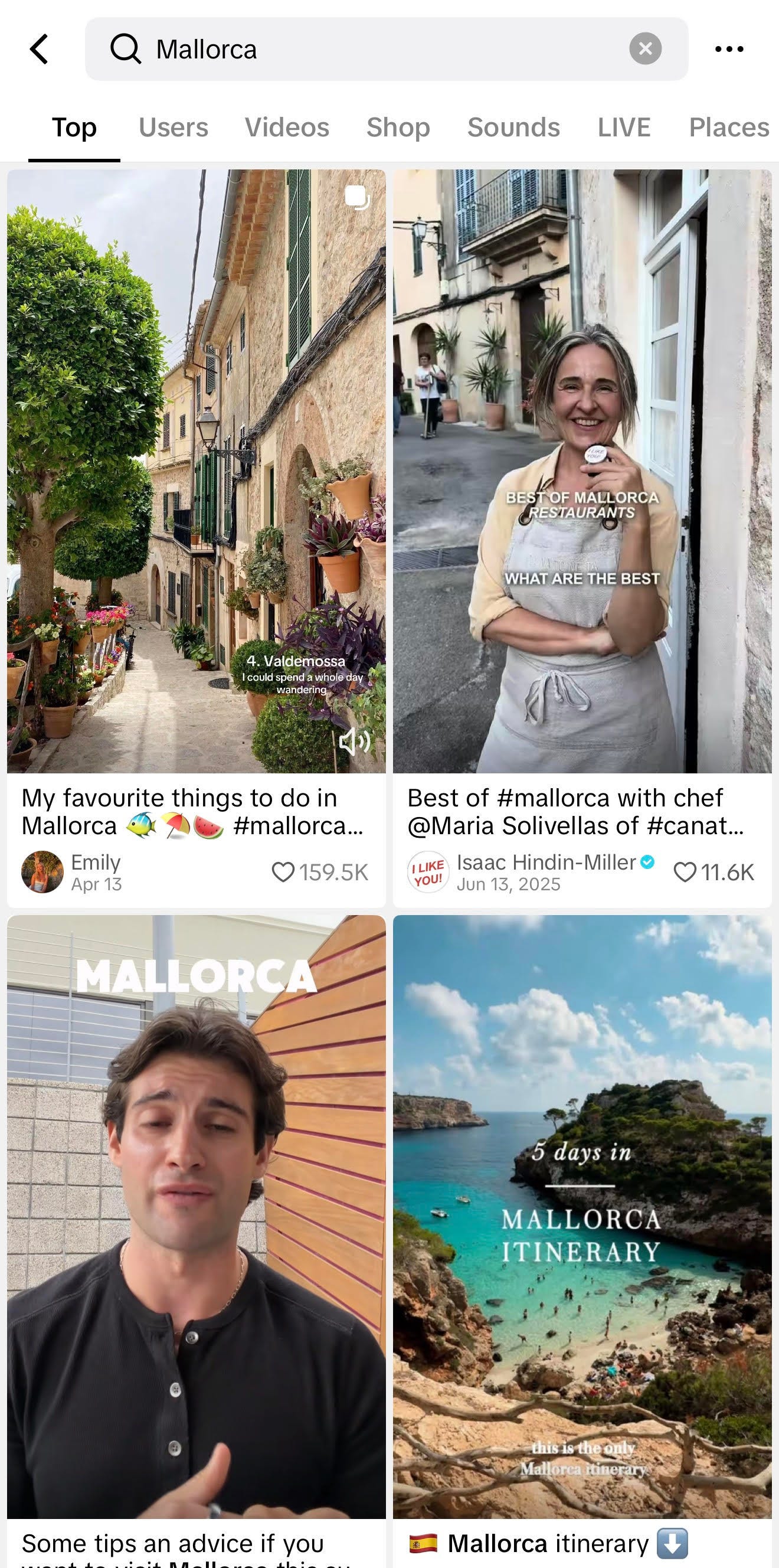
The creator economy knows this. Travel influencers no longer post just vacation dumps of alluring visuals and luxury hotel stays; they also give you tips on how best to spend your time over a specific number of days. Popular travel TikToks now lead with lists and rankings of ‘must-sees,’ some even confined to the number of days you need before you reach diminishing returns. The macroeconomic conditions have forced us to consider vacation like a company stock, in which a trip is supposed to deliver an outsized, quantifiable return on investment; otherwise, it’s a bad buy. The stakes are even higher if you don’t hit the right spots, get the right photo, or visit the right restaurant. After all, is the airfare to Mallorca even worth it if you didn’t snag a reservation at El Olivo?
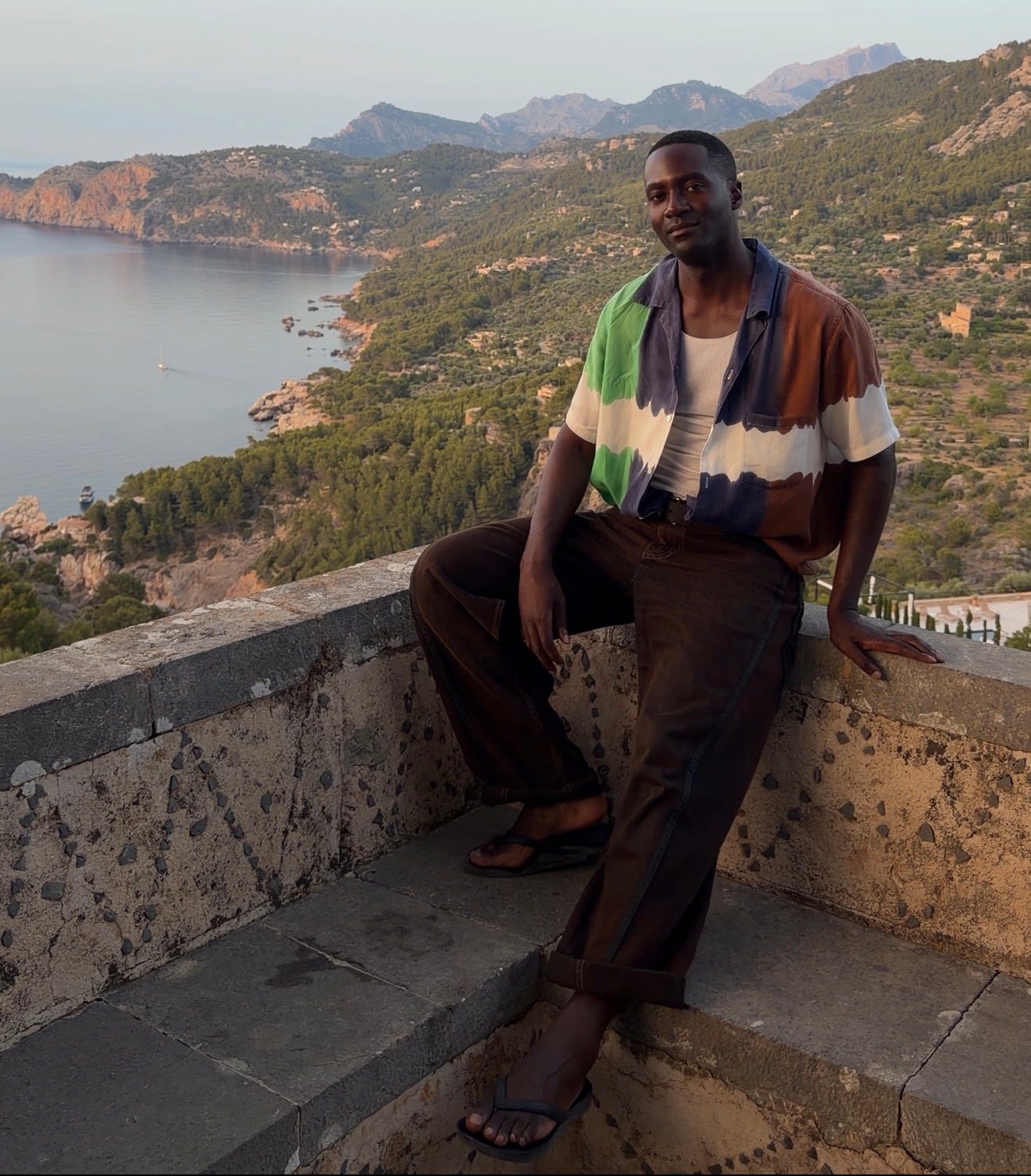
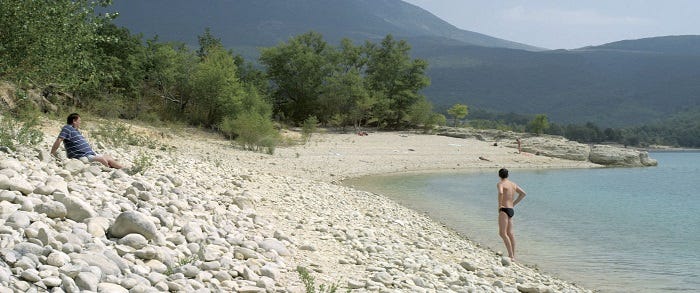
Well, I went to Mallorca last week for my birthday. I didn’t dine at El Olivo but somehow managed to beat the odds and have a great time. After, I headed over to Paris just in time for the harshest heatwave France has ever faced, diving headfirst into some good bites and a bit of Men’s Fashion Week. On the night of my arrival, I grabbed dinner with some friends and, over some focaccia and rigatoni, was introduced to Julia Khan Anselmo, the founder and culinary leader of Feisty Feast, a food-based agency that delivers exceptional culinary experiences. I had been following Julia’s work for a couple of years, and naturally, wanted to get her take on the roster of restaurants I had booked for the week – Bistrot des Tournelles, Clown Bar, Waly-Fay. In retrospect, I was likely just as interested in hearing her recommendations as I was in having her validate my own taste, but upon asking for her opinion, Julia gracefully rejected the premise of the question. She explained that, to her, travel and dining were about exploring and discovering your own tastes, rather than having a list handed to you. While in favour of trying new places and taking a recommendation or two when it made sense, Julia didn’t appear to be as fussy about optimizing for the right dining spot for the right moment with the right table right at sunset as I was, which was surprising to me given her field (and her incredible reco for a lunch spot in Mallorca earlier that week). I found her approach refreshing and honest, and aligned with how I think about exploring film, literature, and music. But within the world of food, I’ve never been that care-free or exploratory. I can’t be a chill, cool girl when it comes to a holiday meal, but perhaps I’m not as literate in the culinary arts to quickly scan a menu’s ingredients and know if it’s going to be great or not. As a result, I am more tilted towards the Hard Sun ethos of dining in Vacationland, while Julia was more aligned with Supergoop. But there’s a lesson to be learned. That evening, I was the one who made the reservation after an extensive search, and now, I can confirm that it was the worst meal I had all vacation.
Technology has become a vacation destination in its own right — the passport, travel agent, and travel brochure of Vacationland. It’s the place where the trip is planned, from where the inspiration is drawn, and the engine that facilitates the coordination and booking. It is also where Vacationland is immortalized within a feed and promoted through posts to inspire new trips. I am an avid reviewer of my friends’ Google Maps lists, consulting many on trips this year to Mallorca, Mexico City, Tokyo, and Los Angeles. It fuses the mechanical itinerary of Vacationland with the humanity of a friend’s endorsement. Due to this, it feels quite natural that the app tapped our Chief Vacationer-at-Large, Dua Lipa, the most prevalent passenger of Vacationland, to be its spokesperson. Through a partnership with Service95, Dua Lipa’s recommendation platform, the artist publicly shared twelve lists on Google Maps, ranging from bookstores in Cape Town to natural wine bars in Bangkok to record shops in Jamaica. When I skimmed the lists, I was surprised by the familiarity of her recos, and how concentrated the spots were, mostly focusing on already popular, ‘run-through’ vacation destinations. While I believe this has much to do with Dua saving some gems for her and Callum, I do think this is also related to the warped scale of Vacationland. The pervasive power of technology and algorithms has made the world of Vacationland a lot smaller than the world we actually live in. We are all on the same loop, headed towards the same flight path and itinerary. We bump into acquaintances at random at coffee shops and beaches over a hundred kilometres from our homes and pretend it’s a coincidence because assuming the alternative, that we are all governed by the same hand, would be a truth too devastating.
But before we get too down on ourselves, let’s also interrogate the premise of a vacation. If the whole point of a vacation is to relax and to not think and to avoid labour, does a vacation also need to be original? Are our instincts of embodying the Anthony Bourdain approach of travelling off the beaten path, and “not being like the other girls,” actually misguided, or worse: a vapid, aesthetic choice in itself? In Vacationland, both originality and conformity lead back to the ego in the end. I reconsider my reaction to the popularity of some of Dua Lipa’s choices. Sometimes the most popular things are popular because they are the best. So much of our cultural explorations have become saturated by the peer review economy — Goodreads users validate books, Letterboxd users validate movies. It makes sense that travel and leisure would inevitably follow suit.
It is too early to tell if AI is a friend or foe in Vacationland. I enjoy speaking to my friends about their vacation highlights and doing my own research to plan a trip itinerary, so I’m not interested in AI replacing that step of the process. I book my personal travel on a private browser and my business travel on phone calls with human agents because I suspect that cookies (not the good kind) will somehow tell the airlines that I am in the market and drive up the price.
But what I don’t enjoy is having to compare prices of airfare for a trip that I am likely already planning too late. To remedy this, I have been experimenting with Arden, a native AI travel agent that autonomously searches for deals and better seats in the background. While the technology has yet to save me money on flights, it has gotten me seat upgrades (Airline status point arbitrage is an advantageous lever of Vacationland) and handled the check-in process for me. With the cost of domestic and global travel on the rise, and the pressure to execute the perfect vacation ever in our rearview, I suspect that this will continue to be a market that AI companies enter under the promise of optimization.
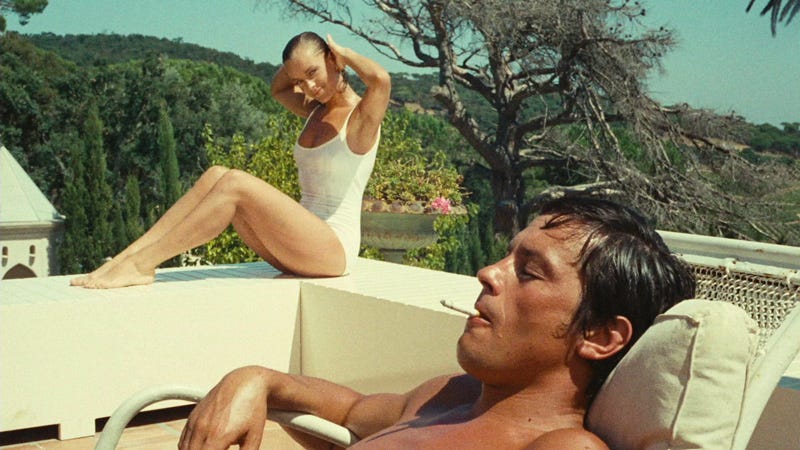
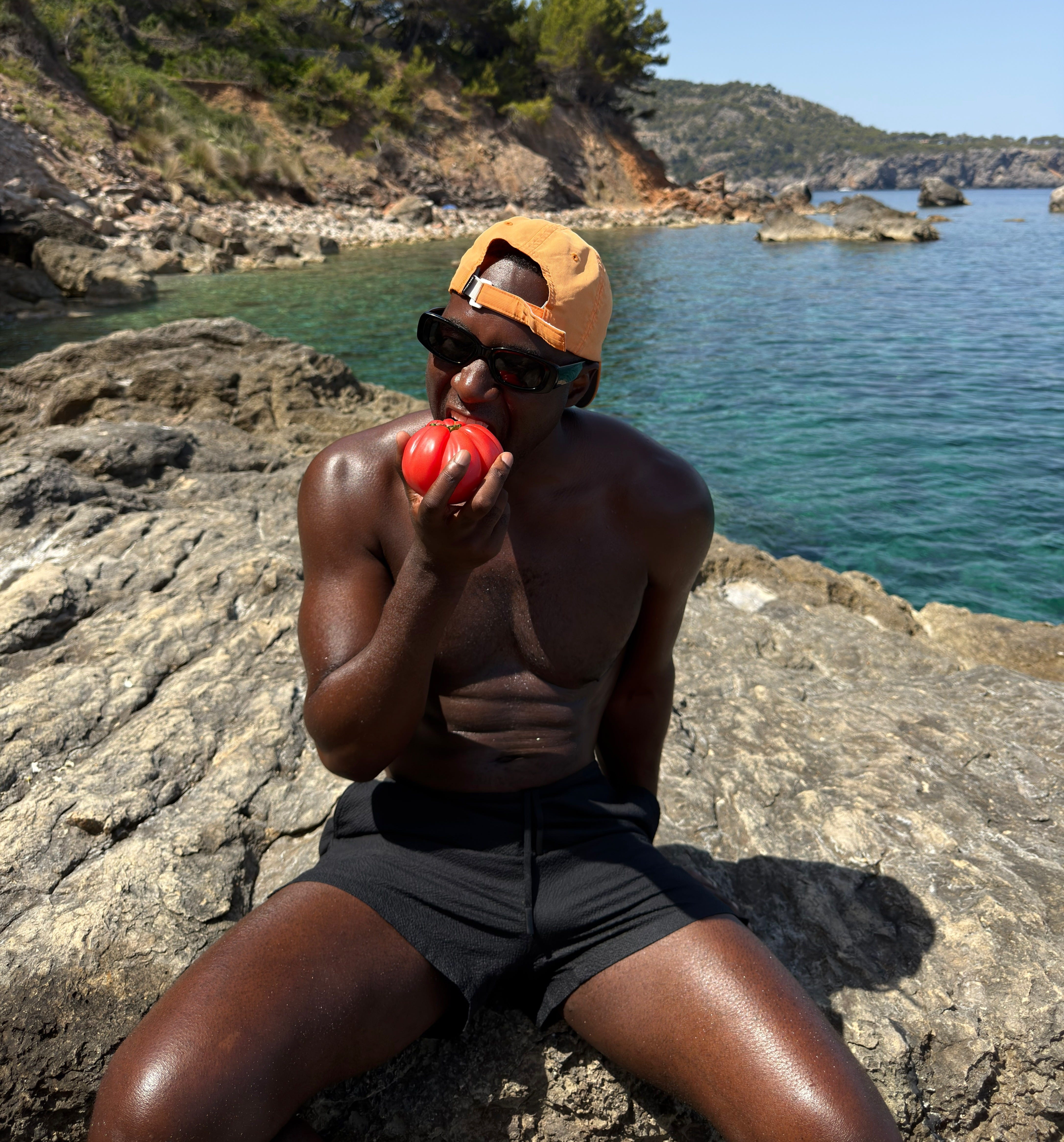
One of the most identifiable attributes of Vacationland is how universal its terrain is: the Instagram story of hot dog legs akimbo and diagonal to a La Piscine-coded poolside; the fluorescent, amber haze of an Aperol spritz wet with condensation; those disappointingly hideous Emilio Pucci dresses; the toothy chomp of a ribbed Loewe-like tomato on a rocky beach somewhere. Somewhere. You could geotag the location of your grid posts, but you don’t really have to. The photos could exist anywhere because they actually live in the same place. The internet and vacation economy have not only centralized where to travel, but also how everything looks and how we render it to our audience.
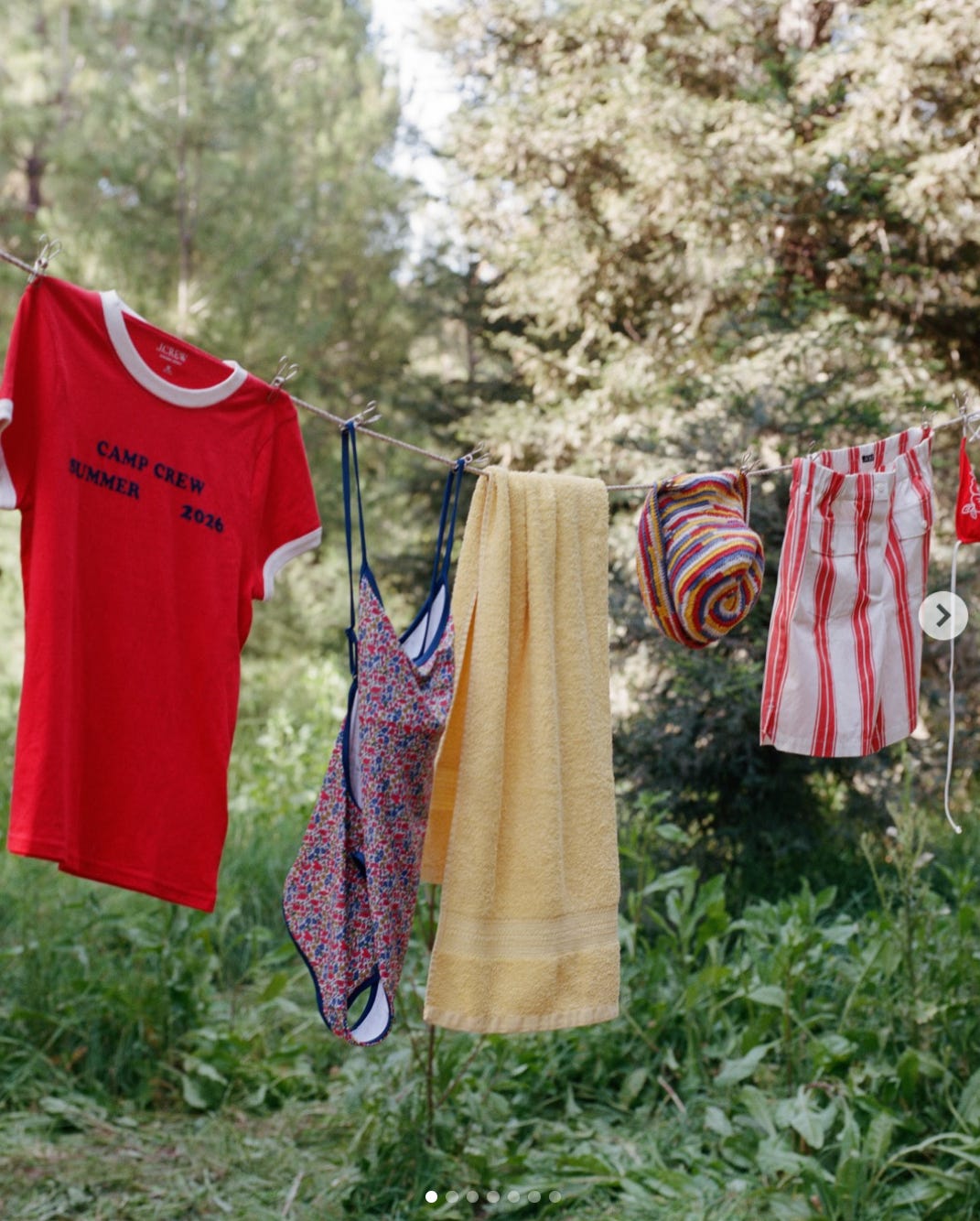
The image attributes of Vacationland are best brought to life through fashion and apparel campaigns. Within the latest J. Crew editorial, Vacationland is summoned through an American summer camp. Picturesque imagery of models outdoors wearing bright coloured bikinis, ringer t-shirts, and sardine rollneck sweaters — because what’s Vacationland without tinned fish? — populate the interiors of the campaign. J. Crew’s models pose with camp flags and spray themselves down with hoses. They jump in the lake to cool off and playfully get on top of each other’s shoulders. There are dad hats and plaid towels, damp clothes that crinkle and wave as they dangle from clothing lines.
It’s enticing. The vibe is entirely Americana, strategically winking at the upcoming United States Semiquincentennial. It poses the idea that the perfect summer getaway is just at a lakehouse or cottage, a couple of hours from your house. This, of course, speaks directly to the precipitating cause of modern Vacationland: the rising costs of airfare. If Americans cannot afford to fly abroad or even to another state for vacation, J. Crew happily presents an alternative: that the ideal — and more importantly, most cost-effective — holiday exists in your backyard. America first.
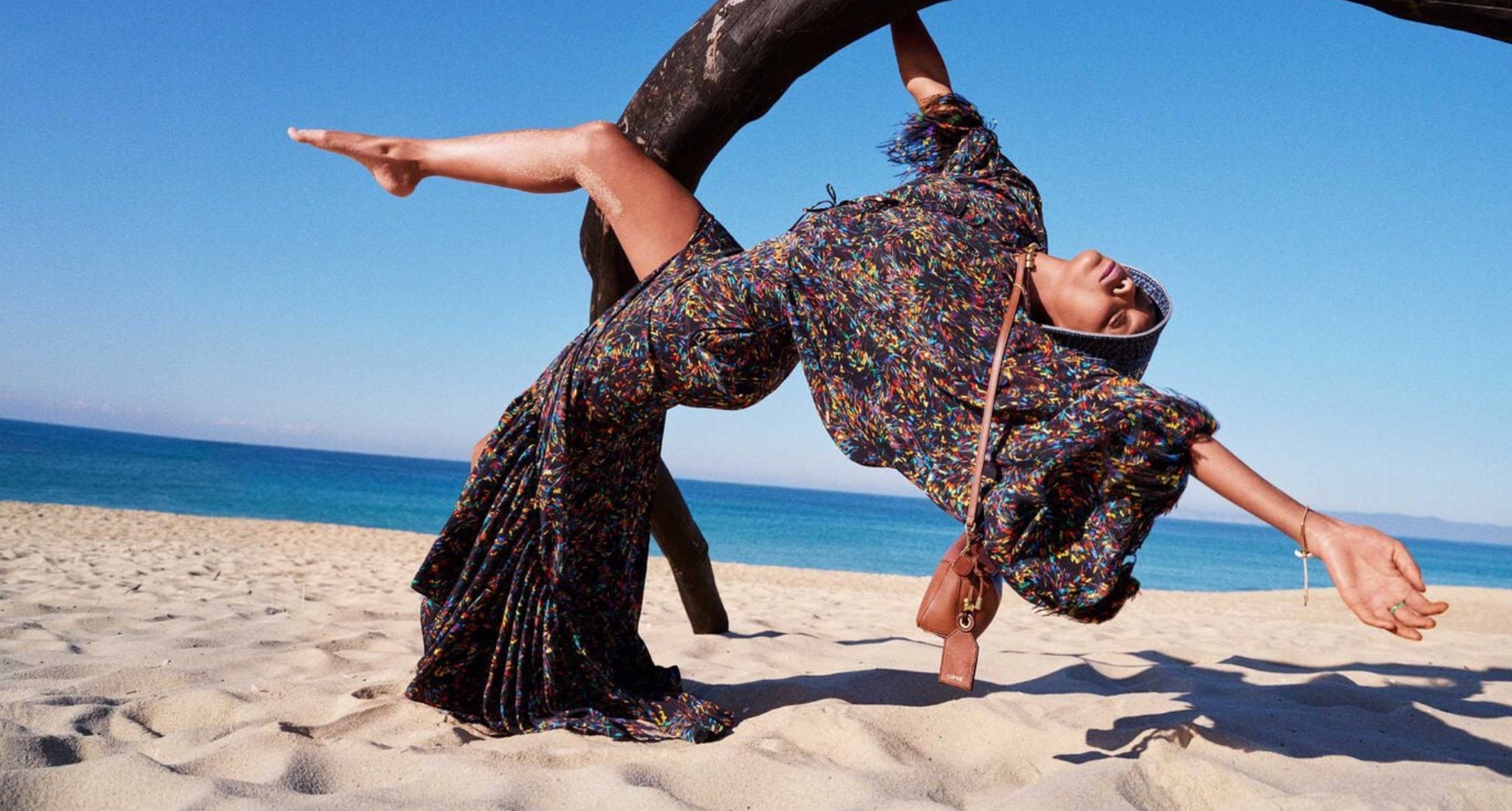
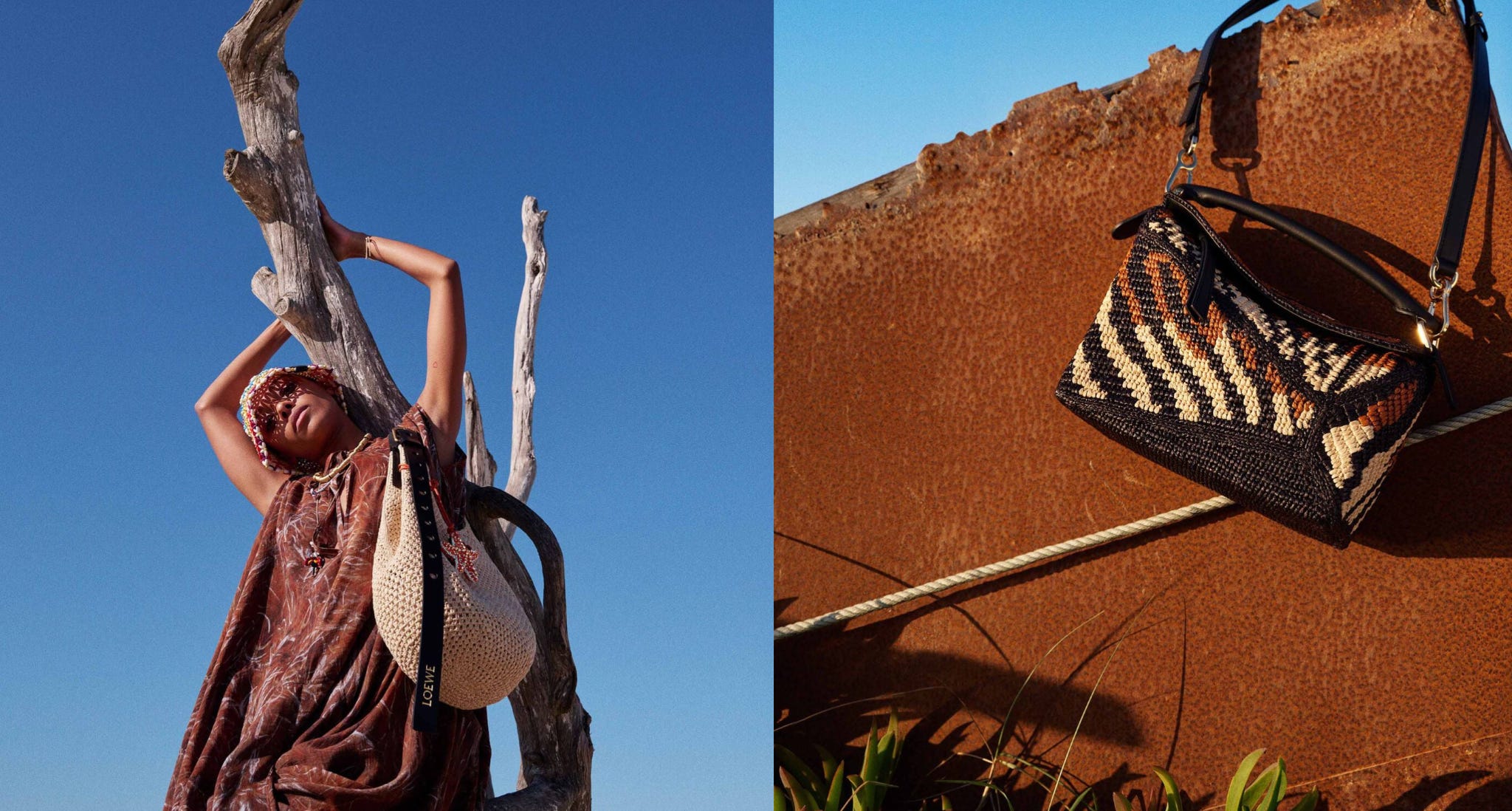
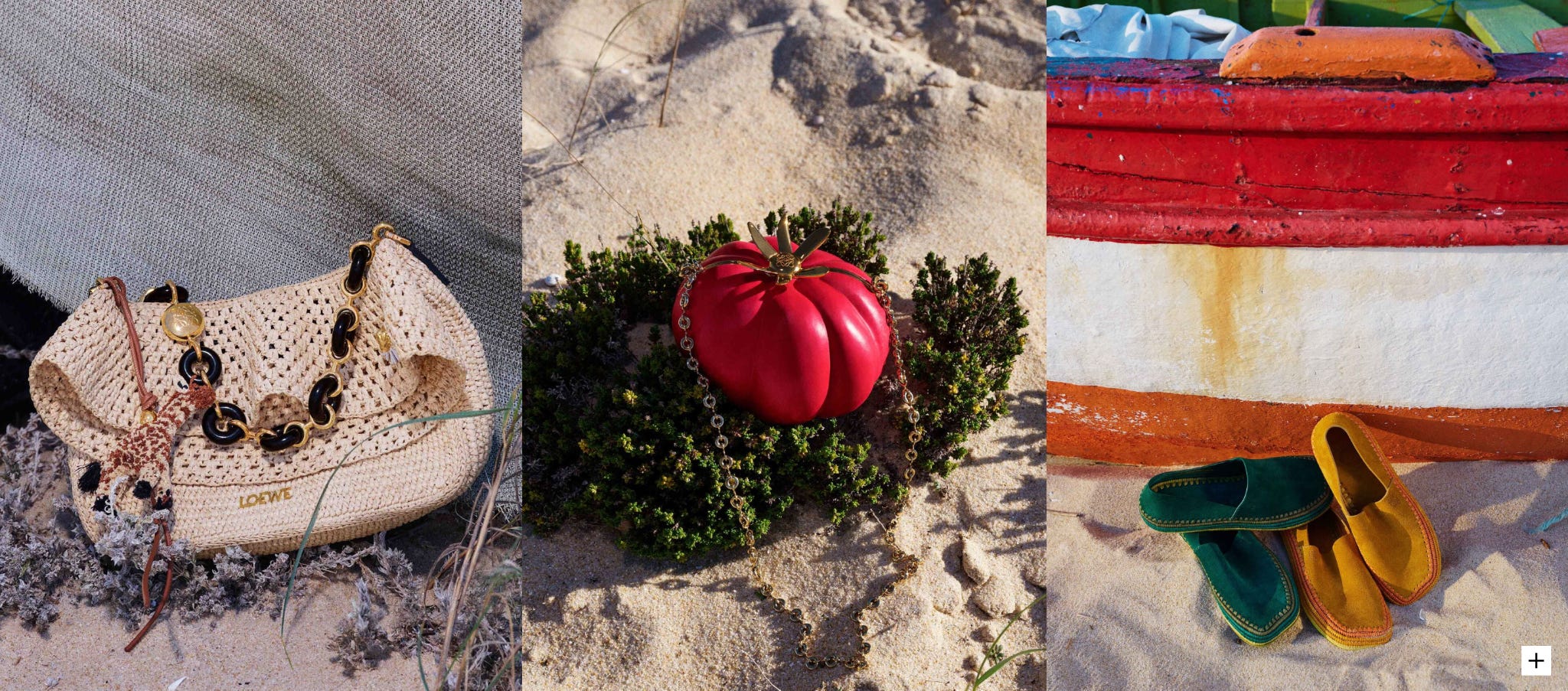
The Spanish luxury brand Loewe takes a similar approach of exemplifying domestic travel, albeit at a scale that is more legible to a global audience than J. Crew’s. In a recent campaign, the fashion house revived the cult-classic boutique Paula’s Ibiza as inspiration, an island shop known for dressing both rock stars and hippies in the ‘70s. The collection features vacation-ready apparel: models donning intricately designed handwoven baskets while traversing the beach in lacy sandals and framboise crochet fisherman hats. In one image, actor Jamie Dornan gazes pensively at a beach bag above the headline: Feel at one with the environment. The iconic Loewe red tomato makes an appearance, too.
What’s fascinating about the Loewe campaign is that you don’t need to know what Paula’s Ibiza is to get what the luxury brand is evoking. Whereas the destination in the J. Crew work is so distinctly American, the Vacationland of Loewe could be just about anywhere. And that’s by design. The website copy says ‘Island Life,’ and if you bother to read the description, you know that the inspiration is Ibiza, but the actual campaign setting itself is barren of any Spanish island landmarks or identifications. As an audience, you can picture yourself in the world of Loewe, but be on a beach in Barbados or Thailand, and it’s this homogeneity that speaks to the flattening of Vacationland.
Even though Loewe and J. Crew’s advertisements physically occupy different beaches, lakes, and bodies of water, they occur spiritually in the same place. Vacationland is synonymous with globalization. This is most evident in the migration of cultural objects and food, divorced from their origin yet somehow endemic to Vacationland. You can get Mexican tuna tostadas at a beach club in Bodrum, Japanese cheesecake at a boulangerie in Paris, and a pistachio scoop gelato pretty much anywhere. In Vacationland, every destination is interchangeably flat, Pangea-esque, and without borders. The menus are all in English, and the waiters speak it, too.
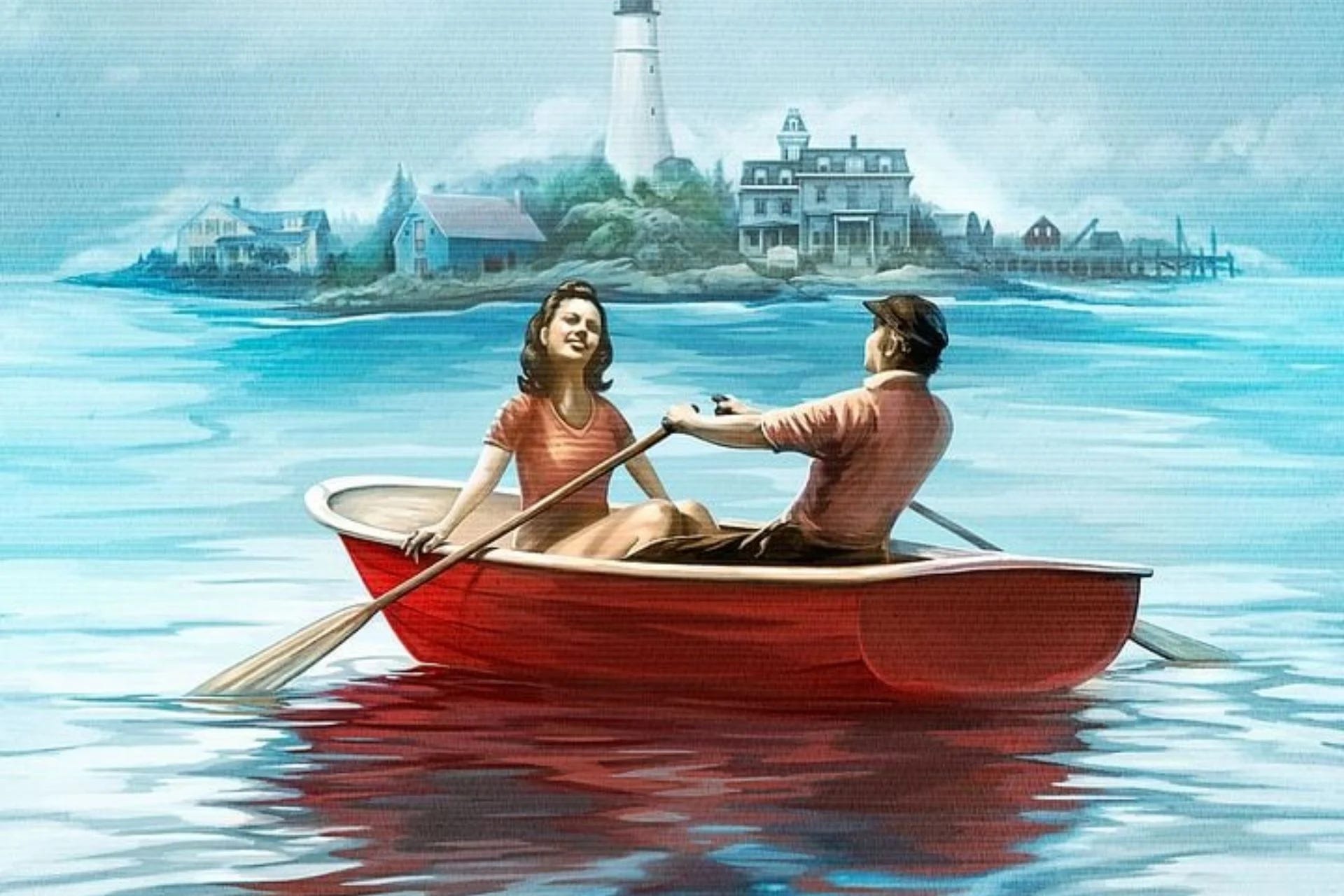
The discourse around vacation, its optimization, and what it should look like, has been in the culture for a while. HBO’s The White Lotus has long satirized our inability to leave ourselves behind as we embark on vacation. We watch as the systems and social structures of the characters’ origins tag along like unwanted carry-ons at Vacationland-ready resorts. The more recent Widow’s Bay subverts this anxiety. Rather than the vacationers bringing their own taxing baggage on their trips, it’s the pre-existing baggage of the vacation town that haunts the characters. In this new AppleTV series, the actor Matthew Rhys (who I’ve stanned since seeing him in my favourite episode of Girls, ‘American Bitch’) plays the mayor of a sleepy, overlooked town in New England. He is desperately trying to bring economic prosperity to the town, the titular Widow’s Bay, by re-imagining it as a vacation destination à la Martha’s Vineyard. But the bay is actually cursed… And the more the mayor attracts tourists to the town, boosted by coverage in The New York Times, the more the supernatural terrors escalate, beginning to trouble the bay and its occupants. I am still making my way through the series, and hope to get through more episodes on my flight home from Paris, but I can confirm that episode 4 is up there with the recent HBO Greats: Game of Thrones’ ‘The Rains of Castamere,’ True Detective’s ‘Who Goes There,’ Succession’s ‘Too Much Birthday,’ and Industry’s ‘Dear Henry.’
Similar to The White Lotus, the show proposes that you can’t put an Instagram filter on spiritual rot. Through an expertly mixed cocktail of horror and comedy, Widow’s Bay portrays the extremities of Vacationland, and when our optimization goes overboard. The show zeros in on an aspect of Vacationland that, up until this point, this essay has tacitly omitted. It flips the lens to focus on the pains those indigenous to popular vacation destinations undergo to commercialize, homogenize, and ultimately bastardize their homes to become Vacationland. Despite the mayor’s attempts to apply a glossy sheen of the Vacationland aesthetic to the town, the dark undercurrent of the bay’s origins remains. He cannot scrub out the history and culture of the town or its inhabitants. And maybe that’s a good thing. You can’t outrun yourself on vacation. At some point, the sunscreen wears off, and the veneer breaks, and you have to retreat home. Stay out too long, and you’ll get burned.
LOOSEY is a bi-weekly newsletter about culture, technology, and the way we live. If this is something you like, consider subscribing and sharing. Let’s be friends on Instagram.
There is a very weird contradiction between neoliberal individualism and the sort of monocultural drive of capitalism to make the experience a commodity.
I think overall a strong sense of self is important to ensure your vacation doesn’t become a labor. That being said, I spent the weekend offline with a bunch of my commie friends in Central NY and felt more relaxed than my weeks spent on the beaches of the Mediterranean.
You have touched on several of my interests, and what immediately came to mind was our tour guide in San Sebastian: ‘They want Disneyland.’ Living in London for over a decade, I have borne witness to the (already underway) shift in the European tourism industry.
Miles Orvel has an older piece (Understanding Disneyland) that might interest you. He argues that the theme park (and similarly shopping malls) satisfied the need "for order, for mastery, for safety, and for adventure". These spaces are 'virtuous' representations of our society. There is no chaos, but also no political reality - this is the danger in the privatisation of public space.
Take Pharrell using Paris as his own little seaside amusement park for Louis Vuitton. Turning public space (and water) into a private spectacle, while burying his head in the sand to the climate emergency.