

The Politicization of the Spectacle
super bowl halftime show, epstein files and political entertainment

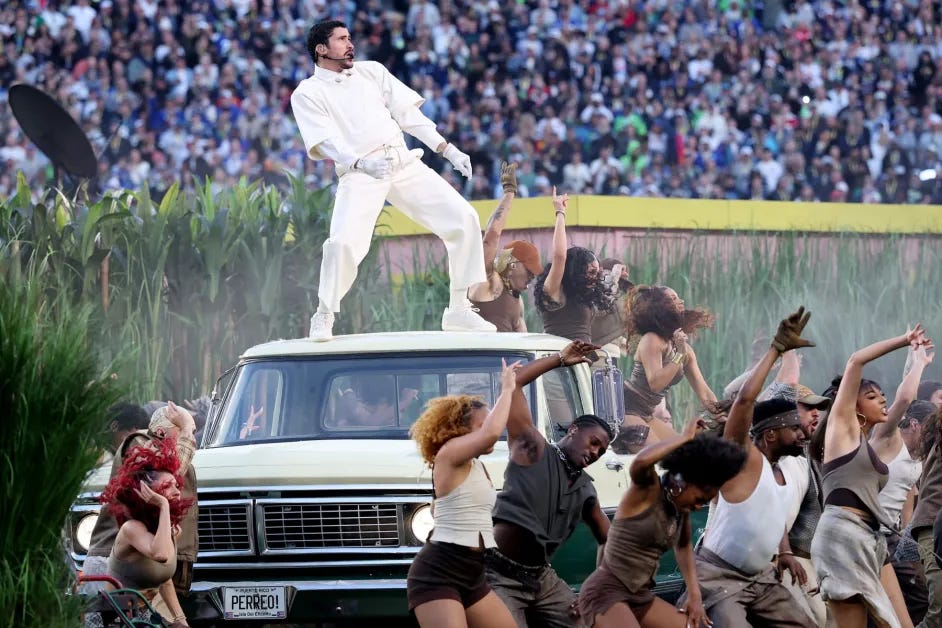
At the 9:12 mark of last week’s Super Bowl Halftime Show, Bad Bunny steps through a cluster of sugarcane and into a family’s living room. He comes bearing gifts, handing his gold-plated Album of the Year trophy to the youngest member of the family — a boy. The boy grins in delight as the camera lurches in for a close-up, all but eclipsing the family’s television screen in the background, which is playing the actual footage of Bad Bunny accepting the award just a week prior at the Grammys. I learned later that the awarded child was a five-year-old actor and model named Lincoln Fox, cast as a young Benito Antonio Martínez Ocasio before he became the prolific Bad Bunny, watching the award show as a hopeful child. Within the multi-layered theatre of his Super Bowl performance, this scene was meant to symbolically nod to a “dream big” moment fit for the Marty Supreme press run. But those who are familiar with the way the Super Bowl and public spectacles like it function are aware that there are often two narratives at play. The first is what actually happened and the artist’s intention, while the second is how the spectacle is interpreted, synthesized, and discussed within culture. How the two converge, through accuracy and analysis, largely amounts to a wider discourse, no longer owned by the artist and, instead, shepherded by the public. Or whoever has the largest platform.
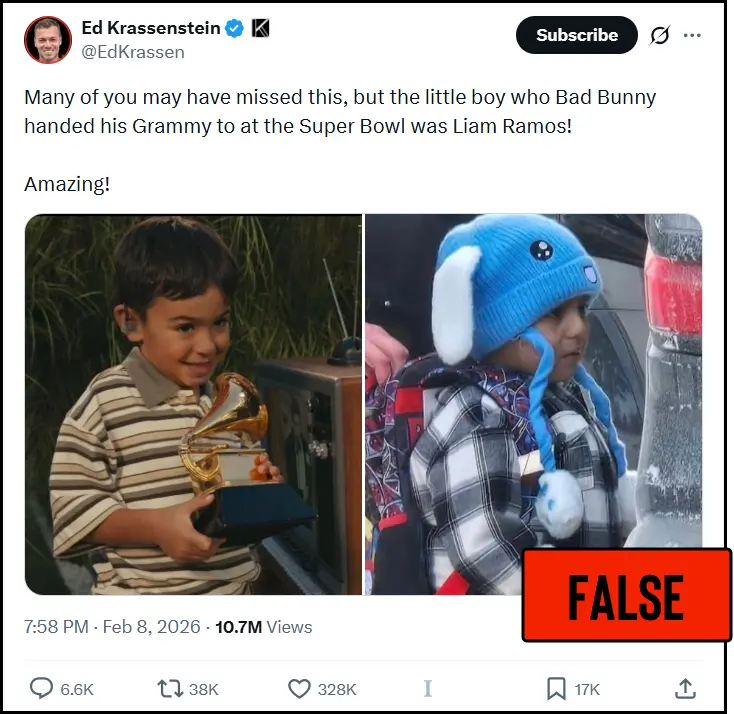
For a few minutes, after Bad Bunny’s historic performance wrapped, the prevailing narrative was not that he had handed the trophy to an actor playing his younger self, but that he instead gifted it to Liam Ramos, the five-year-old boy savagely detained by ICE in Minneapolis. This short-lived theory was plausible: the boys are the same age, look similar, and the angle of the Super Bowl close-up strangely mirrored the angle of the widely shared image of Ramos at the time of his detainment. But how fast the theory proliferated, at a scale and velocity that outpaced some of the more substantive and artistically impressive elements of Bad Bunny’s performance, is reflective of a larger cultural expectation at hand. Today, in a time where trust in the government and legacy media institutions is at a historic low, audiences are hungry for the largest vehicles in entertainment to platform a political narrative, even when there might not actually be one.
Americans who say they have a “great deal” of trust in traditional media – think legacy newspapers such as The New York Times and The Washington Post – have fallen to an all-time low of 28%. This lack of trust is experienced across all voting demographics, with Gallup reporting that “Republicans’ trust plummeted to 8%, Democrats’ trust declined to 51%, and independents’ trust remains at 27%, showing widespread media skepticism.” From a capacity perspective, these organizations are resource-constrained, some no longer having the infrastructure needed to report and bring geopolitical news to the public. Just last week, Jeff Bezos’s Washington Post cut over 300 journalism jobs. Among the 30% of the local and international news teams axed, a war journalist in the middle of a war zone was fired. With these legacy institutions losing their audience’s trust but also their operating infrastructure, they are being eaten alive from both the inside and out. The research indicates that the American population is more likely to trust individual opinion leaders or journalists than legacy institutions, which explains why a Joe Rogan, Alex Cooper, or Joe Budden presidential endorsement is more powerful than one from The New York Times. Public figures like these engage audiences with a perceived authenticity foreign to the accredited media because of their social media platforms, which simultaneously increases scale without sacrificing intimacy. It also translates to why public figures like Bad Bunny, who shape culture and entertainment, are looked to for a perspective on today’s politics. Still, is the frenzied dissection of every entertainer’s actions for political commentary, be it symbolic or direct, necessary? And moreover, is it even effective?
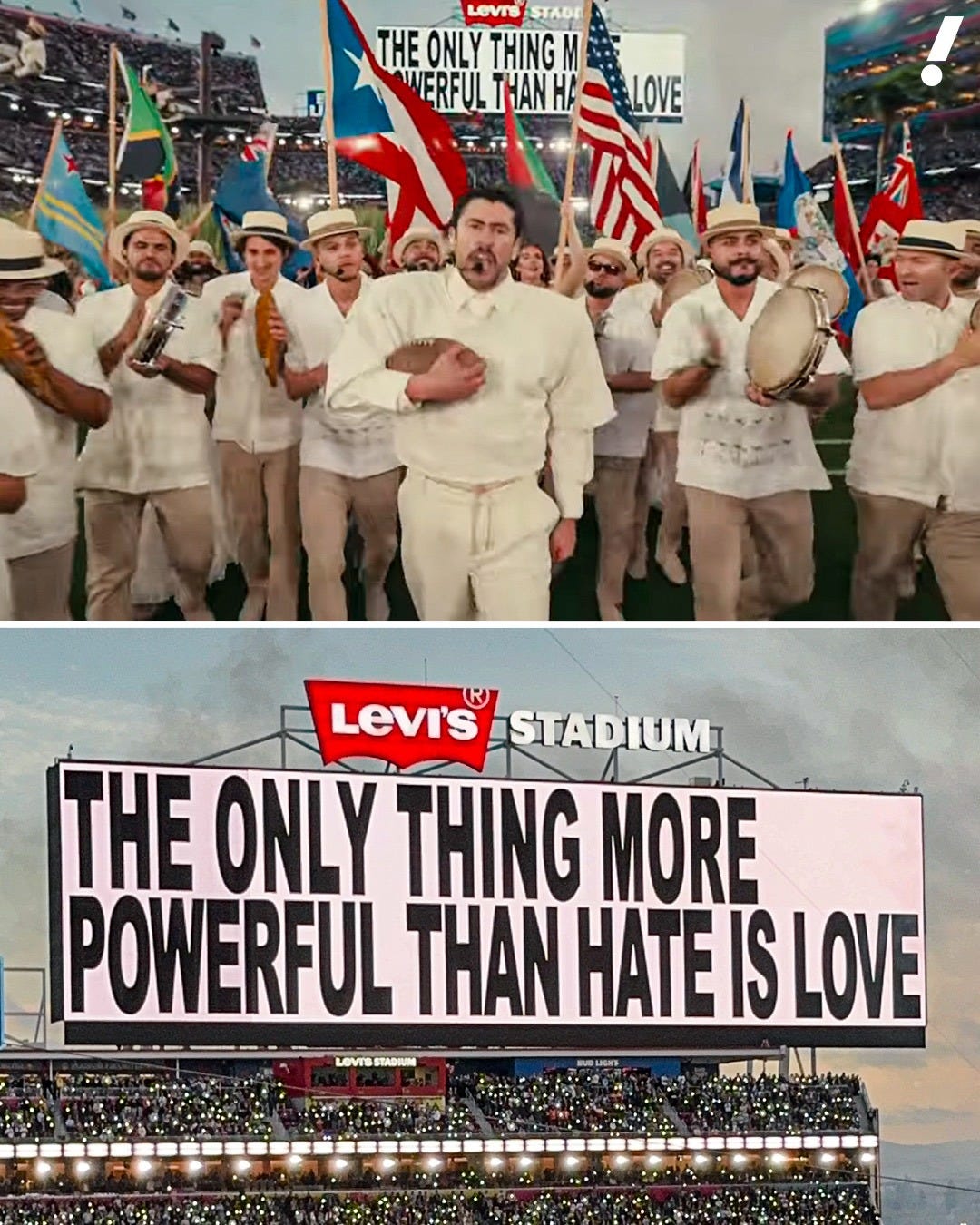
Regarding Bad Bunny’s Super Bowl performance, I do believe the Liam Ramos misattribution comes from a well-intentioned place. At a time when families are being torn apart by ICE agents, and the immigrant community, and those brave enough to support them, are being murdered, there was a lot of curiosity as to how Bad Bunny, the only entertainer to perform at the Super Bowl entirely in Spanish, would handle it. Bad Bunny has gone to great lengths to protect his fans from ICE, including hosting a music residency in Puerto Rico and not having any other concert stops in America to prevent a potential ICE raid. Throughout his performance, in a way that was artful yet direct, Bad Bunny threaded a narrative on the importance of community and migration in one of the most powerful Halftime Show finishes ever, a love letter to the immigrants of America, and a message of hope for all. He delivered.
Several winners in music’s biggest night, otherwise known as the Grammys, spoke out in defense of immigrants when accepting their awards, from Kehlani to Olivia Dean to Billie Eilish. These messages were clear, rather than shrouded in aesthetic veneer, with the artists addressing the political climate effectively and, in some cases, through personal narrative.
Still, there were moments when the message was lost amid artistic symbolism. Within the field of celebrity and entertainment, an endorsement can, at times, feel hollow. That evening at the Grammys, the frontman of The Bleachers and music producer juggernaut Jack Antonoff became the fourth person in history to be awarded in all of the Big Four categories, completing this achievement with a Record of the Year win for Kendrick Lamar and SZA’s ‘Luther.’ Like many celebrities who took to the red carpet that evening, Antonoff was wearing an “ICE OUT” pin to symbolize his opposition to the violent anti-immigration enforcement seen across the United States. Stars such as Joni Mitchell, Justin Bieber, and Bon Iver also donned the pin. Yet, when asked about his pin, Antonoff embarrassingly had nothing to say. I do not know Antonoff personally. I am an admirer of his achievements in developing a generational sound and have held a positive impression of his public appearances thus far, so I’m willing to chalk up his silence to nerves or, perhaps, too good a hit of that California kush, but this brief red carpet blunder is an example of how artistic expression can fail. How can symbols like the “ICE OUT” pin speak for us when the wearer has no teeth? Maybe that is the magic of art and entertainment, that it can speak when we can’t. More generously, when words fail, art steps in. But in times like these, we should expect more. And maybe it’s okay if that ‘more’ doesn’t only come from the world of entertainment.
I was parsing through the Epstein emails, searching for the names of my opps as one does, when I came across this 2014 exchange from Jes Staley, the former CEO of Barclays:
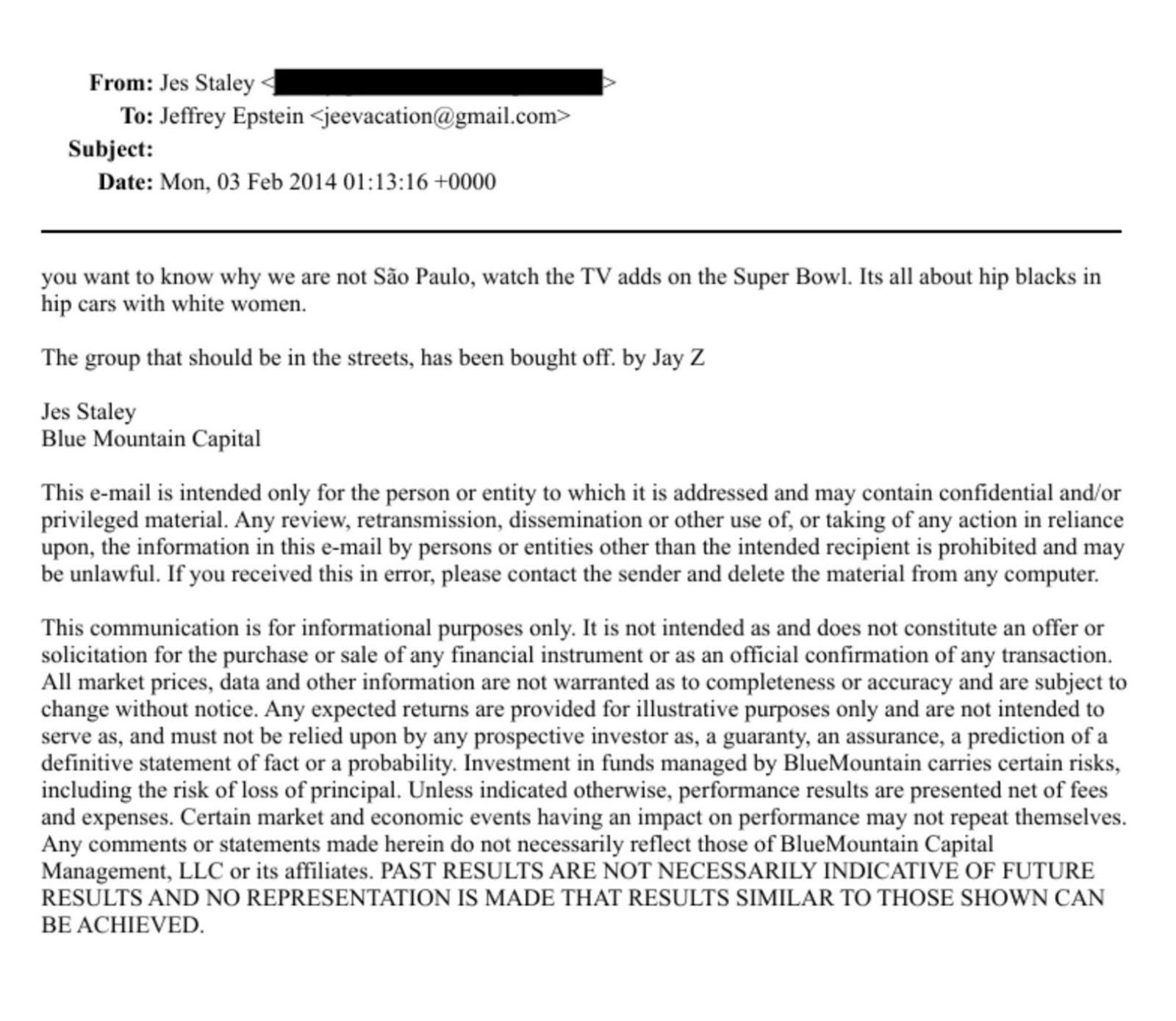
The ‘São Paulo’ incident Staley refers to in his email concerns the “Não vai ter Copa” protests in reaction to the Brazilian government investing billions into hosting the 2014 FIFA World Cup. The civilians of São Paulo were infuriated by the lack of investment in schools and hospitals, while the government was pouring money into entertainment. Subway workers went on strike two days before the games, freezing transportation in the city, and riots broke out in the streets with violence and tear gas. To quell the unrest, the government conceded, enacting an emergency medical program and hiring thousands of doctors to help staff local clinics. They also reduced a previously increased subway fare by 20 cents. The contrast Staley draws is still relevant over a decade later. In the West, we can become so preoccupied with the culture war and satisfied with symbolic representation that we are losing the actual war on the home front. The foresight of Staley to specifically name Jay-Z, who is now in charge of producing the Apple Music Half Time show, speaks to how we can sometimes see entertainment as the sole war to be won, rather than just a mini battle, working in conjunction with a bigger offense, for what needs to be upheld.
The developing reaction to the release of the Epstein files is important to watch. Its muted outrage and headlines so far confirm the relationship between politics and entertainment. The neural network between the two factions – the entertainers and the audience – is blunted on both ends. On one end, some of today’s most vocal public figures have not mentioned the horrific findings within the released emails, materials that point to an alleged system of childhood sexual assault and the suggestion that the U.S. Department of Justice is complicit in its attempts to cover it up. I am not of the camp that believes we need a celebrity spokesperson for every single issue, but it is odd that a universally bad thing, like sex trafficking underage girls, with some of the emails alluding to activity with babies young enough to need pacifiers, has gotten little response from the prevailing celebrity class. A class that is so acutely aware of the modern expectation to ‘speak out.’ Platforming this should be an easy lay-up for any public figure seeking goodwill. On the opposite end, it’s even more disturbing that a significant amount of the public does not know about the details of the files, or the fact that the President of the United States is the most named person in the files. There could be many reasons for this, one being that it requires actual reading, but Clinton had an affair, and it was global news. What is being suggested in the emails is inarguably worse, and yet the coverage and subsequent outrage have been on the quiet side. Why is that?
I did some scratch analysis and looked at the Google Trends search terms to compare Bad Bunny’s search history to the Epstein files, as his Super Bowl performance coincided with the time of the files’ release, and found that Bad Bunny’s search interest spiked while the Epstein files did not. This shouldn’t be a surprise, as Bad Bunny is a global superstar who just performed at the Super Bowl, and Jeffrey Epstein is only just becoming a household name. Interestingly enough, three of the top search queries for Bad Bunny were questions asking if he burned the American flag.
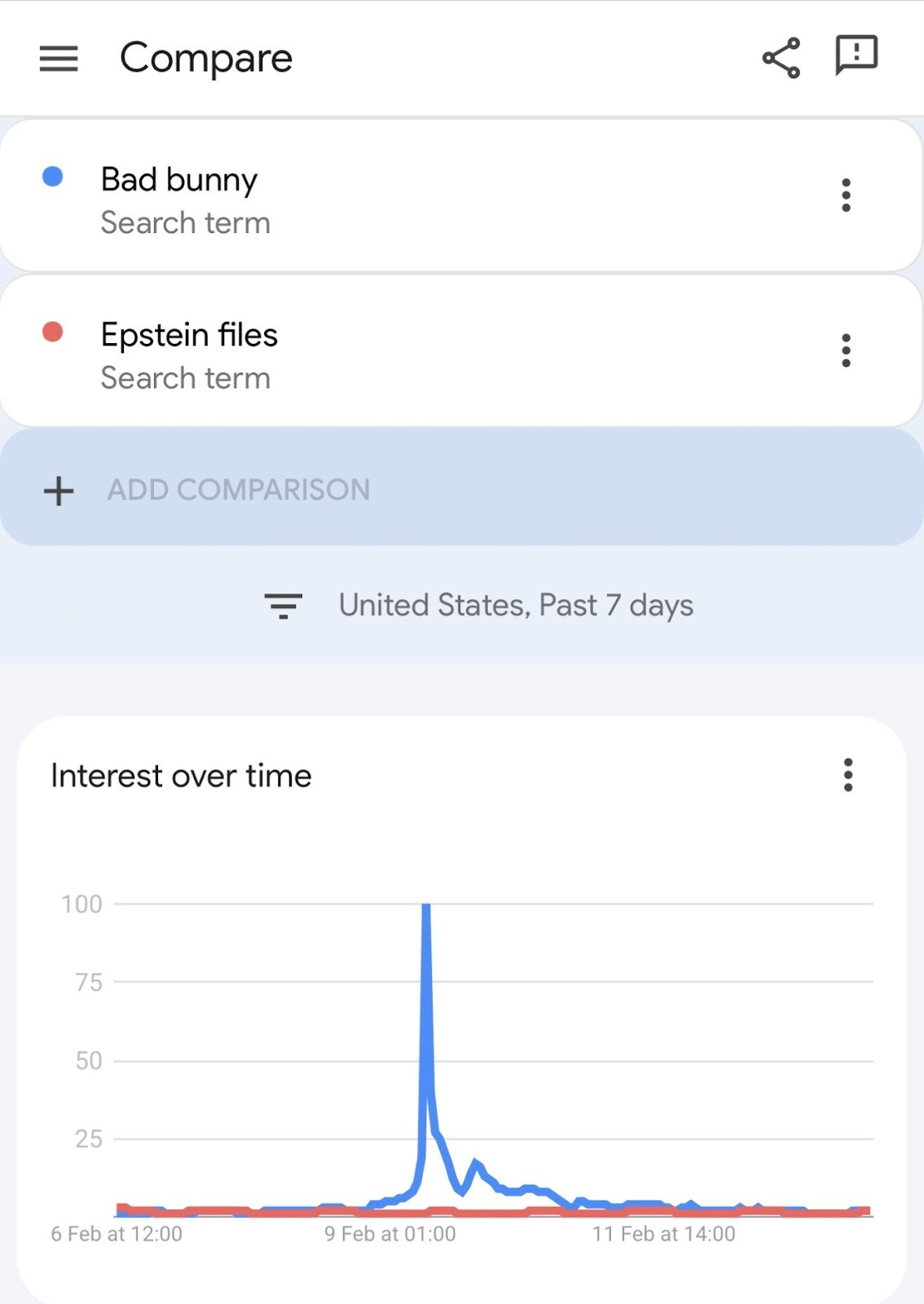
Still, this points to a more worrisome conclusion that I have about entertainment’s ability to serve as a container for politics, which is that we have been groomed to only digest information when it is clipped, polished, and presented to us as a form of entertainment. I think about how people are making connections to Ghislaine Maxwell through Yasmin Kara-Hanani’s narrative arc on HBO’s Industry, or Ukraine’s skeleton racer Vladyslav Heraskevych, earning headlines for being disqualified for wearing a helmet featuring the Ukrainian athletes who died in the war. Will people only care about the Epstein files once it’s inevitably adapted into a Ryan Murphy limited series? If that’s the case, I already have my pick on who to play Pam Bondi, and I’m afraid you’re not going to like it.
While some of our favourite artists have been silent on the ICE raids, Bruce Springsteen has not. In his new song “The Streets of Minneapolis,” the singer offers solidarity with the city, scorns the ICE agents, and memorializes those who have died by name. For Springsteen, an artist whose catalogue is synonymous with American values, this feels important. It’s a deliberate fusion of modern-day progressive ideals with “American tradition,” two things that don’t need to sit on opposite ends but have often been weaponized against each other.
Part of the wonderful aspects of art and culture is its ability to capture and express ideas. Through it, we build empathy, discuss political ideology, and platform thinking that legacy institutions are not equipped or incentivized to speak on. I think about great works like Toni Morrison’s The Bluest Eye, a book that is frequently banned in the United States, and its capacity to educate a diverse body of readers on the longstanding impacts of racism through its symbolism and prose. Bad Bunny’s Debí Tirar Más Fotos is also powerful in its ability to weave a story about migration, gentrification, and the loss of cultural identity and still make that ass shake. I grew up very differently from both artists, and yet found so much that resonates in each of their individual works. I’m sure you do, too.
But Morrison is the best-selling and most awarded Black female novelist on the planet, and Bad Bunny is the world’s biggest pop star. We can’t hold all artists and entertainers to this standard. The efficacy of the political message relies on the talent of the artist and, unfortunately, not everyone has the range. As a public, we cannot be conditioned to think that all of those who create entertainment and art have the ability to heal the world. We must demand more from elsewhere.
The novelist Kurt Vonnegut has a quote that I think about every time I try to assess the role of art and entertainment in politics. His view is one of pessimism and defeat:
“During the Vietnam War... every respectable artist in this country was against the war. It was like a laser beam. We were all aimed in the same direction. The power of this weapon turns out to be that of a custard pie dropped from a stepladder six feet high.”
Although he may rightfully believe that the efforts of artists weren’t enough to stop the Vietnam War, I do think we have to fight hatred with whatever tools we’ve got. For some, that’s a song; for others, that’s a vote. For some, that’s legislation or a strike; for others, that’s a paintbrush or a Super Bowl halftime show performance. For me, today, it’s an essay.
Thank you for reading. If it’s within your ability, please consider supporting the organizations below:
Stand with Minnesota to support families impacted by ICE.
Amica Center provides legal services for individuals to help navigate the immigration system in the U.S.
International Rescue helps rebuild Gaza by providing aid to families in need.
LOOSEY is a newsletter about culture, art, technology, and the way we live. If this is something you like, consider subscribing and sharing.
Yes yes yes, we have to understand that people in the entertainment industry are not going to save us! Even if Bad Bunny had Liam in the half time show, ( which I thought that was a little embarrassing someone actually thought those two little boys were the same person) it wouldn’t have done anything to keep other little boys from getting deported. Bad Bunny performing the half time show, while an incredible performance, is not going to change our material conditions. No one’s coming to save us, we have to save ourselves.
Who’s your pick for Pam bondi…