

Justin Bieber, Lena Dunham and The Trick Mirror of Self-Portraiture
on frida kahlo, bieberchella, famesick, the mayhem ball, death of a salesman

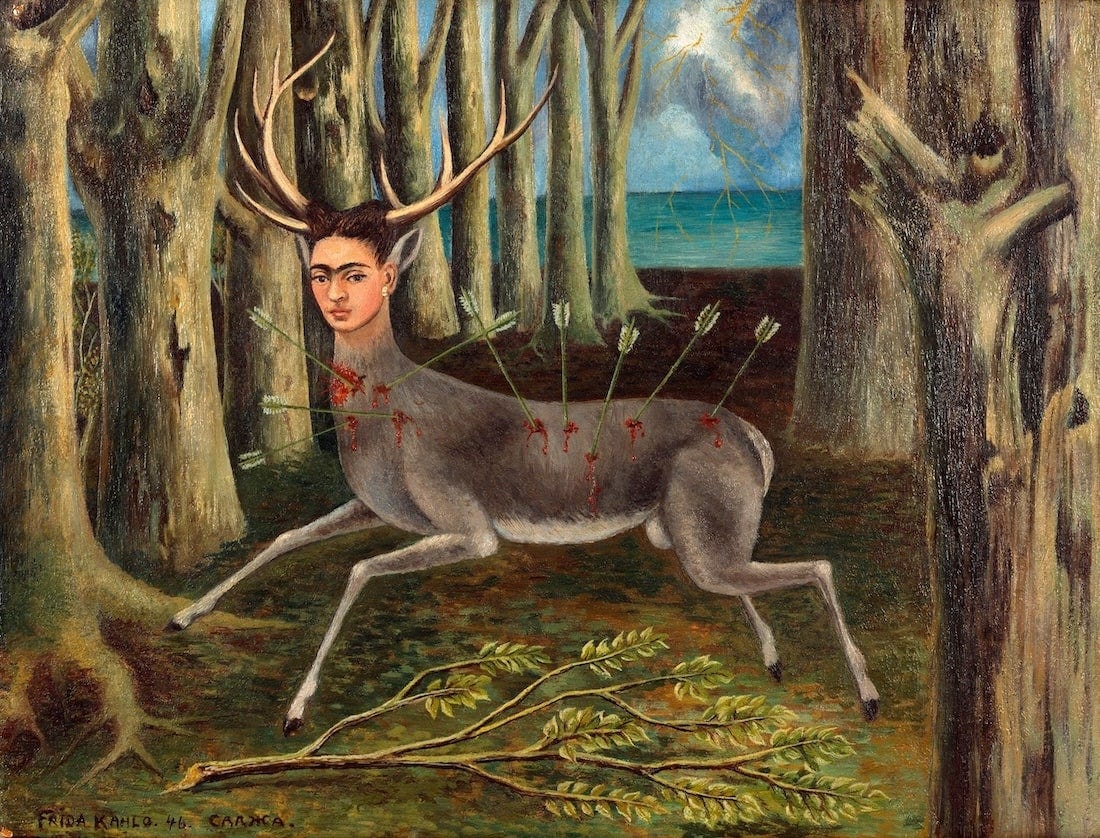
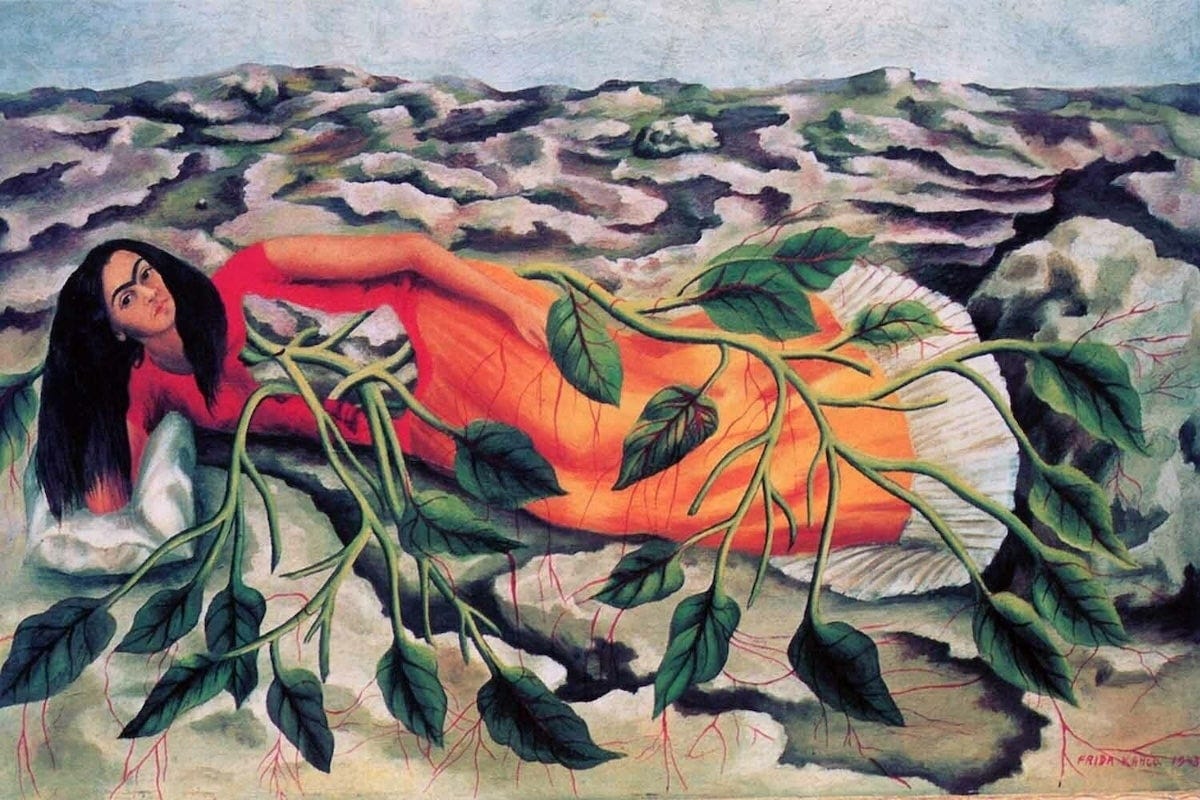
In 1946, after a botched spinal surgery left her bedridden for a year with chronic pain, Frida Kahlo turned herself into a stag. “The Wounded Deer” is one of the Mexican artist’s most arresting self-portraits, depicting her antlered head fixed to the body of a deer fatally wounded by nine arrows. Illuminated by forest twilight, the injured deer leaps across a broken branch as a storm throbs on violently. Painted towards the end of her life, when the severe pain she first encountered from a bus accident twenty-one years prior was at its sharpest, Kahlo imagined what it would be like to trade places with her pet deer, Granizo, and escape her sickness.
However, the fragile trees and fractured branches that shroud the deer reveal Kahlo’s inability to outrun the illness that trapped her like a cage. Out of her 143 paintings, 55 of Kahlo’s were self-portraits, the majority of which were inspired by her severe physical and emotional anguish. Kahlo was able to narrate her pain through these artistic vignettes, and with it, establish herself elsewhere. When nearly thirty-five surgeries failed her, she could confine herself to a canvas, and perhaps, have her sickness leave her body, if only for a moment. “I am not sick, I am broken,” the artist said. “But I am happy as long as I can paint.”
Despite her paintings’ surrealism, Kahlo often depicts her face with striking clarity. In “The Wounded Deer,” with her torso bloody and struck, the beauty of her face remains untouched as she gazes at the viewer with composure and confidence. This is how Kahlo wants us to see her and perhaps how she sees herself.
When an artist swaps verisimilitude for narrative, the self-portrait becomes a trick mirror that is warped in the subject’s favour. The result can be more powerful and sustaining than the lived reality. I’d reckon that the craft of memoir and autofiction is similar. Throughout the past week, I inhaled nearly everything related to Lena Dunham’s newly released memoir, Famesick, with highlights including her New York Times interview, her gold standard Substack book tour, her New York launch event at the Brooklyn Academy of Music (BAM), and, of course, the memoir itself. Under the dim lights of BAM’s Howard Gilman Opera House, in an auditorium of Brooklyn’s most enthusiastic Mamdani canvassers and NPR-tote bag wearers, I sat a few rows away from the author as she read through an abridged version of the seventh chapter of Famesick on a stage that had been decorated as a bedroom, equipped with the comfy-looking arm chair that Dunham sat in, a king-sized bed with floral bedsheets and more pillows than I could count that she’d later climbed into with Girls co-star Andrew Rannells for an excitable Q&A, two side tables that flanked the bed with stacks of books that were unfortunately too imperceptible for me to make out the titles, yellow slippers and spare clothes tossed about, and two night lamps that dueled across from each other with the hospitable glow of Lumiere from Beauty and the Beast.
The artist read. Despite not hearing much from Dunham in the years leading up to Famesick’s release, I found that the familiarity of her voice shot through me instantly like a lightning rod. It felt like hearing a long-lost friend’s voice note for the first time in years and immediately forgetting about the distance, the time. A superficial feeling of closeness that I’m certain has been conjured by a healthy dose of parasociality on my side and the author’s habit of oversharing over the years. Who could blame us?
Dunham’s voice, which has inspired countless millennial writers since the genesis of Girls in 2012, is as piercing and crystalline as ever. That evening it dawned on me that perhaps the reason her voice was so familiar, even after years of well-earned respite, is because her voice – or a better yet, the facsimile of it – has remained persistent even as she’s slipped away, kept alive by those inspired by her. Their own voices – found in viral personal essays on Substack or The Cut, confessional TikToks that gain engagement for perhaps the wrong reasons, or a new television shows where the lead feels like a spiritual successor to Hannah Horvath – have been forged from the same material as Dunham’s, bolstered by a media ecosystem that rewards anything that resembles her self-referential, cringey-yet-comedic tone. This has a totalizing effect, causing her voice to echo with familiarity even when she’s not there. Like a flood of parrots caught in a steel chamber, mimics of her self-narration lingered on in her absence from public life.
After the book event, I took Famesick home and immediately cracked it open, entering a cycle where, over a matter of days, I read the memoir before I fell asleep and listened to the self-narrated audiobook as I commuted to work or dropped off dry cleaning. Famesick ushers us through Dunham’s early achievement at SXSW with her debut feature film Tiny Furniture, the success and scrutiny she faced with her generation-defining HBO series Girls, the layered and thorny relationships she strained to keep with her now ex-boyfriend Jack Antonoff and her now ex-business partner Jenni Konner, and her biblically unfortunate bouts of chronic illness. It’s a sharp work of memoir because:
The writing is excellent, full of revelatory details and tea-spilling that further saturates one of the most overexposed artists of the past decade;
Lena herself is a fascinating subject who has made a career out of her own self-mythologization, creating her most compelling work when she is her own muse;
And, in a lot of ways, Famesick acts as a cautionary tale with a clear message about what happens when sacrifice is met with artistic ambition and the ills of celebrity.
One of the more illuminating aspects of Famesick was the moments where you could track Lena Dunham’s lived experience to that of her fictionalized protagonists, primarily across major works like Tiny Furniture, Girls, and the recent Too Much. When you trace her creative endeavours to that of what she experienced in her personal life, you gaze through a trick mirror of self-portraiture: the opportunistic fuckboy-film bro of Tiny Furniture who uses the film’s protagonist (played by Dunham) to take residence in her parents’ apartment is based on real life filmmaker Ti West; a real-life unnamed abusive, cleft-lipped lover provides dialogue that is later said by Adam Driver in Girls, which interpolates many of Dunham’s lived experiences through Hannah like when she perforated her eardrum; the problematic musician ex-boyfriend and self-immolating protagonist in Too Much who moves to London is a romantically flawed, comedic stand-in for Jack Antonoff and Dunham, who actually did accidentally set herself on fire in “The Big Smoke.”
These linkages do not make her achievements any less genius; many artists pull directly from their lives. What is considered within Famesick, and its surrounding press, is that perhaps Dunham believes that her self-narrativizing art can allow her to shed the hardships of her past and recast them into something new. Something that is her own.
In a New York Times interview with David Marchese, Dunham remarks on how her early experiences with sexual assault infiltrated her desire, and subsequent shame for BDSM sex:
“There was something about recreating a situation I had been in not by choice, with some measure of what appeared to be my own free will, that somehow made me think that if I executed it right, I could erase the thing that happened to me before. And maybe I will even be loved for my ability to perform well in this kind of dynamic.”
To sensitively extrapolate, this quote could also describe Dunham’s operating approach to artmaking, in which she lifts and reupholsters her lived experiences under her precise written and directorial control, often casting herself as a fictionalized, mirrored figure. This is a self-portrait. By revisiting situations where Dunham may have felt that she lacked control, and developing them into something beautiful or comedic or, at least, in her own image, she can canonize her artful retelling instead of the memory. While this approach has yielded some of the most important works of our generation, Famesick does not suggest that this self-excavation is cathartic. Artmaking can be therapeutic, but it isn’t a substitute for therapy, and Famesick’s chapters are littered with anecdotes of the loss it took to get there – the impact on her family, failures in romantic partnerships and friendships, and, as the title suggests, her health. “The saddest thing looking back was the idea that I thought at the other end of it, there might be something that resembled love,” Dunham told The New York Times.
When I contrast her fictional projects with the memoir, I continue to follow the cycle of self-portraiture as Dunham reinvestigates her past to pen new conclusions. The memoir is gracious to those who have hurt her, and self-critical, even if it’s impossible to be completely unbiased when centering yourself in your own story. In a later chapter, Dunham recounts a conversation with Bruce Springsteen, where he shares advice for writing a memoir: “You do not have to tell the whole truth. You just have to show them how your mind works.”
Being a reliable narrator means much less to me than being a brilliant storyteller. I suppose this is the same with Dunham; after all, this is art we are talking about. I am reminded of my favourite Girls episode, “American Bitch1,” where a disgraced writer (played by Matthew Rhys) tells Hannah that she is not a journalist; she is a writer. There is a difference, and he intends for this distinction to be a compliment. The former’s primary concern is to tell the truth, while the latter’s role is to tell their truth.
What's the difference between facts and the truth?

Dua Lipa’s Service95 team commissioned me to write an essay on Emmett Till to run alongside her book club selection, The Trees by Percival Everett. You can read my piece here. Up until this point, I had never written a profile for a dead person, let alone an American teenager who was lynched on the false claims of…
One full year and five days after the release of Tiny Furniture, another native New Yorker mounted a self-portrait. In Lady Gaga’s “Marry The Night: The Prelude Pathétique,” the artist advocates for the prioritization of artistic portrayal over facts. In the music video interlude, Gaga states:
“When I look back on my life, it’s not that I don’t want to see things exactly as they happened, it’s just that I prefer to remember them in an artistic way. And truthfully, the lie of it all is much more honest because I invented it.”
To be clear, Gaga’s artistic output is much more closely linked to fantasy and self-mythologization than Dunham’s, and I’d never characterize Dunham’s memoir as “the lie of it all,” even though it is a phrase I’d likely hiss over brunch with friends. But there is a connection to their approach to self-portraiture. The singer even goes so far as to link her retelling to the art of painting itself, the act of brushing past and erasing out the past in favour of a narrative that is uniquely her own and, therefore, beautiful:
“It’s sort of like my past is an unfinished painting, and as the artist of that painting, I must fill in all the ugly holes, and make it beautiful again. It’s not that l’ve been dishonest, it’s just that I loathe reality.”
I see this fixation of beauty related to Frida Kahlo’s self-portraits, how the troubling body horror that exists within her canvas rarely disrupts her alluring facecard. It is easy to surmise that Gaga has created the reality she now lives in, one that she willed into existence through a commitment to her artistic persona. The fame she parodied in her early career on projects like The Fame and The Fame Monster has now become her life; her role as Ally in A Star Is Born feels closer to memoir than cosplay. In doing so, Gaga has become the woman in the trick mirror, stepping through the canvas she has painted and trapping herself in the art piece like Dorian Gray, blurring the lines between where reality ends and fiction begins. This is true for many pop stars, their persona fusing with their private selves, and we, the audience, are unable to tell the difference.
On Lady Gaga’s latest concert tour, The Mayhem Ball – which is structured around five arias and lasts over two and a half hours – the artist fictionalizes the dark underbelly of her career as a theatrical gothic, one where two Gagas (the real one outside of the mirror and the superstar trapped within it) must battle to the finish, pirouetting through hit after hit after dance after dance. Despite the outsized production and dramatic stakes, the ball achieves a remarkable autobiographical sentiment, nodding to her real-life injuries, her romantic hardships, and her early success with subtle allusion. Much like the real singer, the dueling Gagas on the concert stage undergo rebirth and madness in pursuit of artistic success. What is lost is her sanity in the end; famesick by a different prognosis.
When I saw Lady Gaga at Madison Square Garden a month ago, the superstar closed her set with the best song on Mayhem, “How Bad Do U Want Me,” a Swiftian-Antonoff-era inspired candy-coated-pop ballad in which a love interest must decide between two Gagas — the ‘bad’ girl or the good girl; the public, mania-inducing superstar or the private introvert. “The good girl of your dreams is mad you’re loving me.” The singer performs this as an encore, live-streaming from her backstage dressing room, de-dragging herself as she strips away her makeup and wig before returning to the stadium as a blank canvas of a woman to feast on her applause. In the end, she breaks the trick mirror, collapsing both ‘girls’ into one with the catchy refrain: “That girl in your head ain’t real, how bad do you want me for real?” As effective as this ridding of identity may be, especially at the end of a lengthy concert performance, it is ultimately still a part of the performance of Gaga and her career-long self-portrait of interrogating fame. We see her the way she has reconstituted herself: as both artist and artist statement, and, ultimately, as a lady.
When someone stays suspended in their trick mirror for too long, they lose the ability to escape their own delusions. Some of the most prevailing art depicts this. Don Draper of Mad Men is revealed to be a fraud and nearly loses everything. In Industry, when Harper Stern is exposed for fabricating her college transcript to land a job at Pierpoint, her firing spirals her into a loss of identity. Even Hannah Montana had to take off that wig before getting lost in the sauce of her own trick mirror.
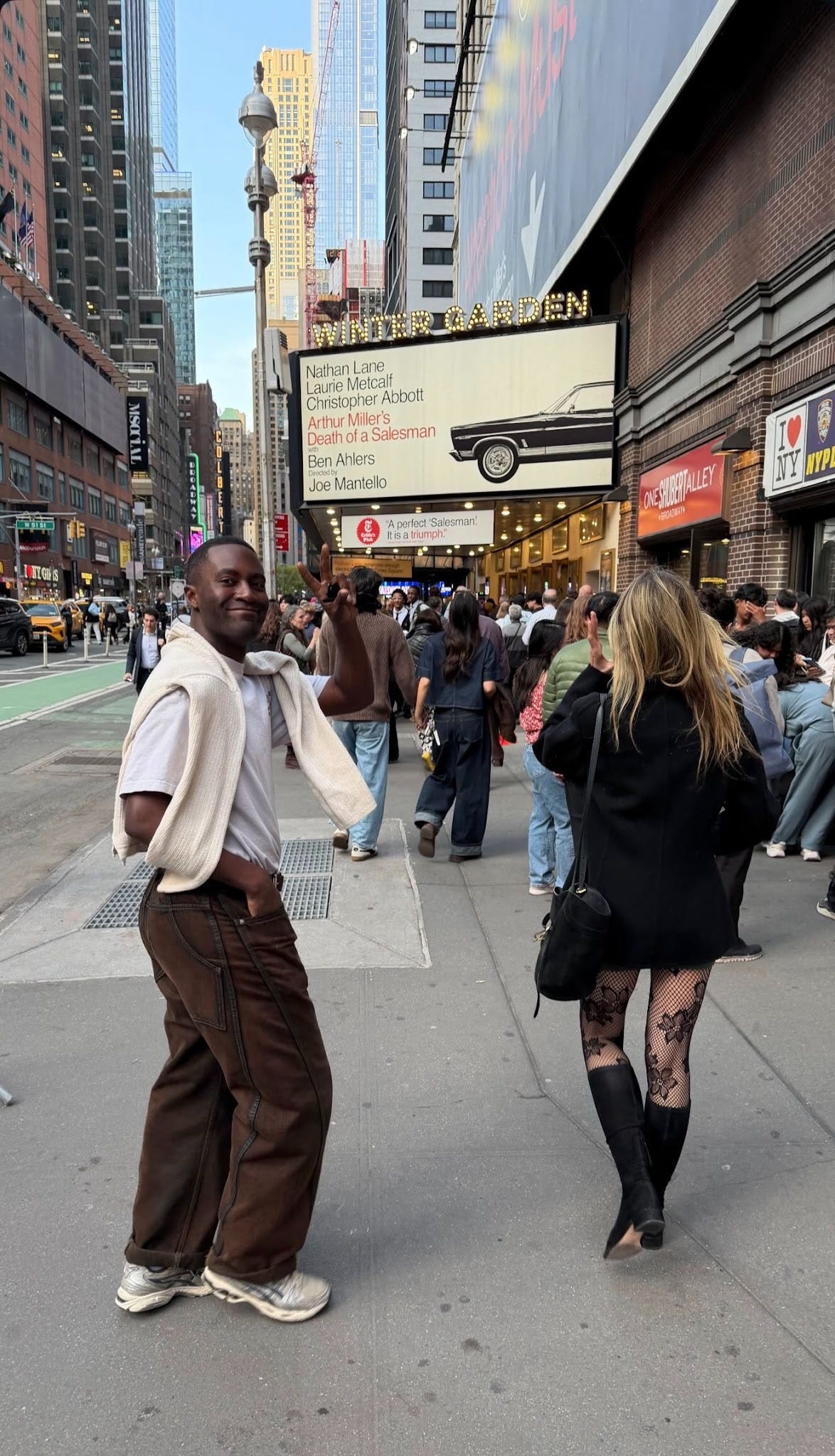
A few days ago, I suffered through the bustling bodies of Times Square to The Winter Garden Theatre and saw Death of a Salesman for the first time. In the production, which featured stellar performances from Laurie Metcalf, Christopher Abbott2, and Jack Falahee, Nathan Lane portrays the titular salesman, Willy Loman, an aging father of two wayward but gregarious sons and husband to a devoted wife – a collective stand-in of the broken American dream.
When we encounter Loman, already babbling, disgruntled, and delirious within the first act, he is bent on remaining in the warped fantasy of his successful salesman youth, “when the going was good,” and he could provide for his family. But that is no longer the reality; as the business has changed, his sales have failed to keep up, sending him into a steadfast denial that threatens the stability of everything he has worked for. We get the sense that Loman’s mental fortitude is both dependent on and destroyed by his determination to remain in this fantasy: the earned gleam of big deals and the affirmative, hearty pats on the back from other executives at the firm that he relives in a delusional fever. The crux of the play teeters between his ability to face reality and staying suspended in his self-portrait. In the end, his refusal to break free from the trick mirror leads to his demise. Everyone suffers for it.
But why is it that Loman’s investment in self-portraiture is destructive, while Kahlo’s is affirming, and Dunham’s is productive? Why is it that Loman’s reality never conforms to the vision he has for himself, while Gaga’s portrait ultimately paints a path for who she is to become?
The reflection in the trick mirror becomes starker, more interrogative when the subject stands next to it. You can pick apart the differences. It’s a jarring moment of truth when you stare at your own fabrication – whether you believe it to be one or not – and confront the portrait for gaps in the reflection. What happens when you truly look at it yourself?
Two weeks ago, in the low Californian desert, the damp night rolled in. The dry heat of the day had long clocked out, giving way to the cold dark, marking its entry with the frigid ramble of dust storms. It was the second night of the first weekend of Coachella, and everyone was curious as to just what Justin Bieber would perform. The singer recently sold his catalogue for $200 million, with hits like “Baby” and “Beauty and a Beat” that painted him as the biggest heartthrob on the planet, and an emblem for boyhood. Would he even touch his older hits at all, or would the performance, with the estimated payout of $10 million, be geared towards his more recent, critically acclaimed projects SWAG 1 and SWAG 2?
Fourteen songs into his performance, Bieber retrieved a laptop that live-streamed his face back to the audience through an inspective fisheye lens. He clicked through YouTube and hit play, karaokeing over tracks from his youth like “Baby” and “Favorite Girl” with the crowd, some songs he had not performed since 2013. Like Dunham recounting her experiences directing Tiny Furniture and the show Industry in Famesick, here was an artist revisiting and reconstituting his past work with new memories. The framing of Bieber encountering the early YouTube videos that catapulted him to success through the reflective mirror of a MacBook was extended through the hundreds of thousands of fans who live-streamed the performance through their own device – a canvas within a canvas within a canvas. The effect was that he was leaving the frame to sit in the audience with his fans, regarding a past creation with minimal narration. To finally acknowledge his reflection was artful enough.
LOOSEY is a bi-weekly newsletter about culture, technology, and the way we live. If this is something you like, consider subscribing and sharing. Let’s be friends on Instagram.

The Rihanna “Desperado” needle drop will always give me chills.
Charlie from Girls, even though his bio in the Death of a Salesman playbill glaringly omitted it from his list of credits.
Only you could’ve threaded all these needles
Master dot-connector