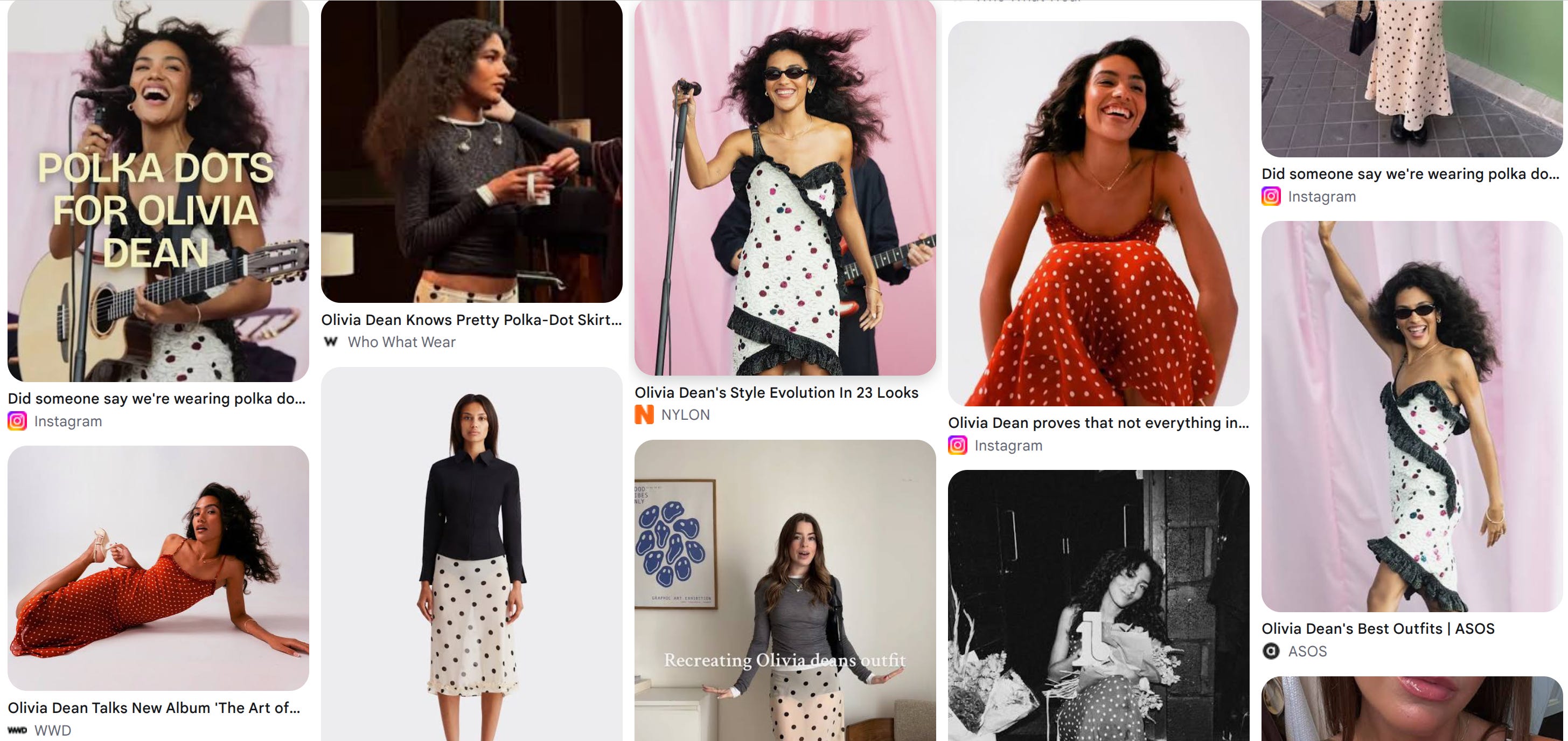
The woman on the t-shirt looks nothing like the burgeoning pop star we are all here to see. Her misshapen eyes don’t match the woman in the official concert poster that beams out to 34th Street through Madison Square Garden’s unrelenting LED displays. As the man jangles the shirt at me, and we bypass him to reach the gate, I notice even more inconsistencies: her reimagined mouth obliterates the volume of her natural lips into a smirking em dash; her noseless visage vanishes any clue to her ethnicity; the black curls that frame her now racially ambiguous face spin her into an elixir of mystery. “Who is that supposed to be?” we sarcastically sneer as we skip past the bootlegger. The depiction of the woman is hard to place, but we can tell she’s young. She could be anyone, and, indirectly, that is part of her appeal. The Olivia Dean that stares out at us from the screen-print of the t-shirt is smoothed; her features hallowed for mass consumption. Flat like a logo. A surrogate for something else. Her image has been remade with plastic ink, too thick to be absorbed by the cotton-polyester fibers of the t-shirt. Over time, like most products, the woman will crack; her mass-produced stand-in will fissure and eventually peel under the weighted fingers of whoever has bought her.
Inside the Garden, there are no plants, but there are lines. The lines for concert merchandise are longer than the lines to scan your ticket, and the floor plan is designed in a way that you must encounter the merchandise before your seats, or the bathroom, or a box of pre-made popcorn, all of which we happily indulge in before the musician we are here to see sings her first note.
Well past the glare of the pop neo-soul singer on the unofficial merch, merchandise that lists all fifty-four tour stops along with the phrases “MAN I NEED” and “SO EASY TO LOVE,” The Art Of Loving Live tour continues to announce itself through consumable goods, items like blankets, fanny packs and cropped tees that prod concertgoers like carrots to a horse, all evoking the same study, the same preoccupation, the same produced testimony of love. Love that is your God-given right, love that is your destiny, and love that, of course, is for sale. Between Olivia Dean and her opener, an American soul singer named Baby Rose, the merchandise stalls are filled with products that speak to the possibility of love through the lens of their lyrics. LIFE LONG YEARNER. LOVE EXPERT. PUT A LITTLE LOVING IN YOUR LIFE. YEARNALISM. WE COULD BE NICE TO EACH OTHER. This sort of branding exercise is expected. The massaging of art into consumable takeaways for concertgoers exists across all shows regardless of the popularity of the artist. Touring, and the associated concert merchandise, are a large component of how artists make a living, a revenue source that has become increasingly important since the devaluation of music sales due to the advent of streaming. But as I look around and sense the desire in so many of the concertgoers’ eyes, a hunger clipped to something beyond the materiality of the music, and more tethered to the spiritual promises of what Olivia Dean is professing, I wonder what else is for sale.

We find our seats, and grab our popcorn and suffer through the last fifteen minutes of the opener. To distract myself, I turn my attention to the demographic of the audience members still trickling in. Searching for a link, but failing to identify a unifying trait. For an artist of Olivia Dean’s size, one immensely popular and impressively barreling towards a bygone tier of monoculture — evidenced by a record-breaking single spending 19 weeks at Number One in the UK and a cluster of her songs from The Art of Loving taking residence within the U.S. Billboard Top Ten chart — it makes sense that the demographic at the Garden would be mixed. You can’t attract a mass without attracting a medley, and around me the arena fills with people of various ages and ethnicities. But as I look closer, I find a pattern, a substitute for something else, once again through the concertgoers’ clothes. Many of the concertgoers are women, in sets of two or three, and some in mobs that rival the size of a bachelorette party. It’s when I see the fifth woman walk by wearing a similar dress to the one I’ve been seeing all night that I realize that Olivia Dean has established a concert dress code: a black-on-white, or white-on-black, polka dot dress. Like the merch, this is par for the course, evidence of the slippery slope all artists face on the path to commercial viability, from culture to commodity to costume. It’s a marvel, a testament to Olivia Dean’s recognizable talent and legibility, that she has reached this apex so quickly. Just nine months prior, she was opening for Sabrina Carpenter in the same arena, and today, she leads four back-to-back sold-out shows.
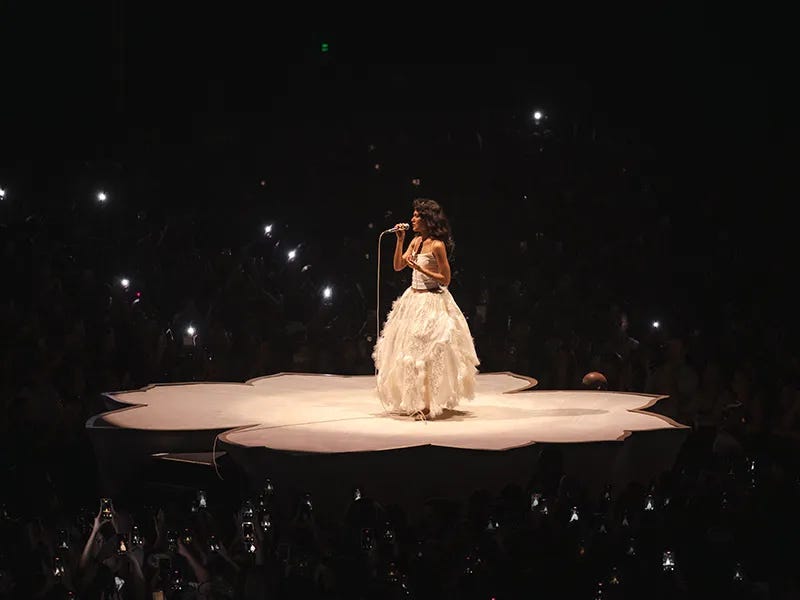
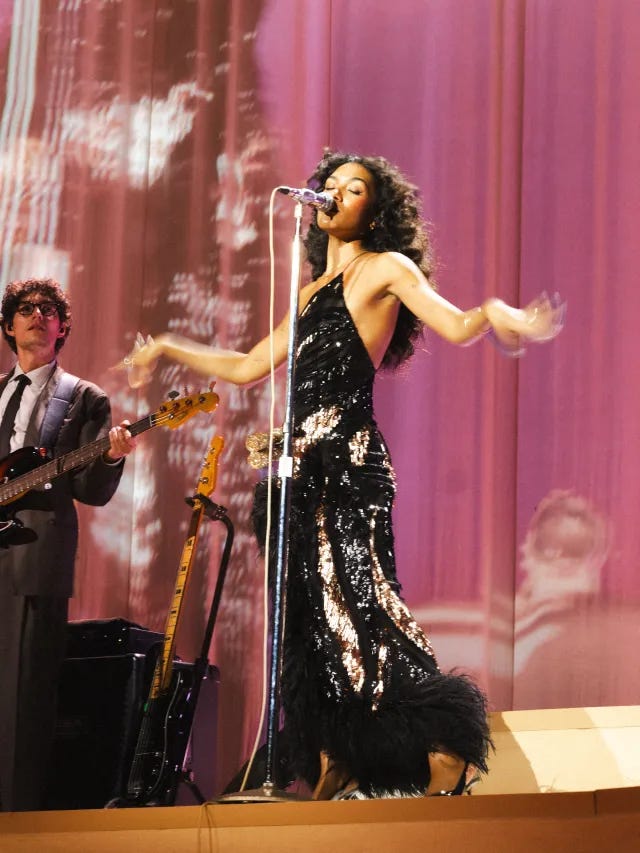
When Olivia Dean first hits the stage, you hear but do not see her. She is veiled by a beige curtain that wraps around the stage. After an intro where she coos about the art of loving, something lost and something gained, the curtain pulls back to reveal the star in a sparkling floor-length gown atop a series of rounded, platform stairs. She is flanked by a band and two backup singers, all dressed for a black-tie affair. The set mirrors the stage production of The Sonny & Cher Show, The Soul Train Awards, and the theatrics of the Motown era, and Olivia Dean and her image directors are aware of this. It’s all material on the moodboard, and she evokes it well: her hair plucked big and large with the right amount of kink, her hands swaying in unison with her Black background singers as done in Dreamgirls, and her jolly skips reminiscent of a solo Diana Ross. After the show, I searched and found one of my favourite videos on the internet, a video of Diana Ross and Michael Jackson performing “Upside Down” at a concert in 1980, and thought, “Yeah, that’s the one.” The woman on the stage looks just like the chanteuses of love of yesteryear. A new authority on love has risen, the production purports.
We spend the majority of the concert on our feet, as does everyone, and are taken by the charm and talent of the star. Her vocals are crisp and full, zapped with electricity as if the urgency she once wrote the songs with is still present within her, the ink from her quill still wet on the page. She dances, gliding from towering steps to the belly of the stage, and moves from piano to guitar, reminding us that she is a musician, not just a singer-songwriter. She generously explains the meaning of nearly every song performed with the excitement of a young artist who is eager to share their work. Nothing is left to interpretation. She speaks of bad breakups, of rekindled relationships, the romance of friendship, and cites bell hooks’ All About Love, drawing light comparisons between the conclusions she shares through her music and the lessons of the text. It is here that her concert exceeds its premise. There is more on sale than the music. These people, these consumers, in their polka dots and their bootlegged merch, have come to feast on a produced potential, the potential of love and its healing properties, and within the Garden have been met with a sermon.
I attempt to parse if Olivia Dean is saying anything new about love. If she is saying anything novel or nuanced about relationships as she looks from all angles. Even though her references are clear, and her show is expertly choreographed, nothing about her or her performance reads as false. It feels completely true for her, and so it must be completely true for us. At least that’s what we want it to be. That’s what we have bought into, and paid for.

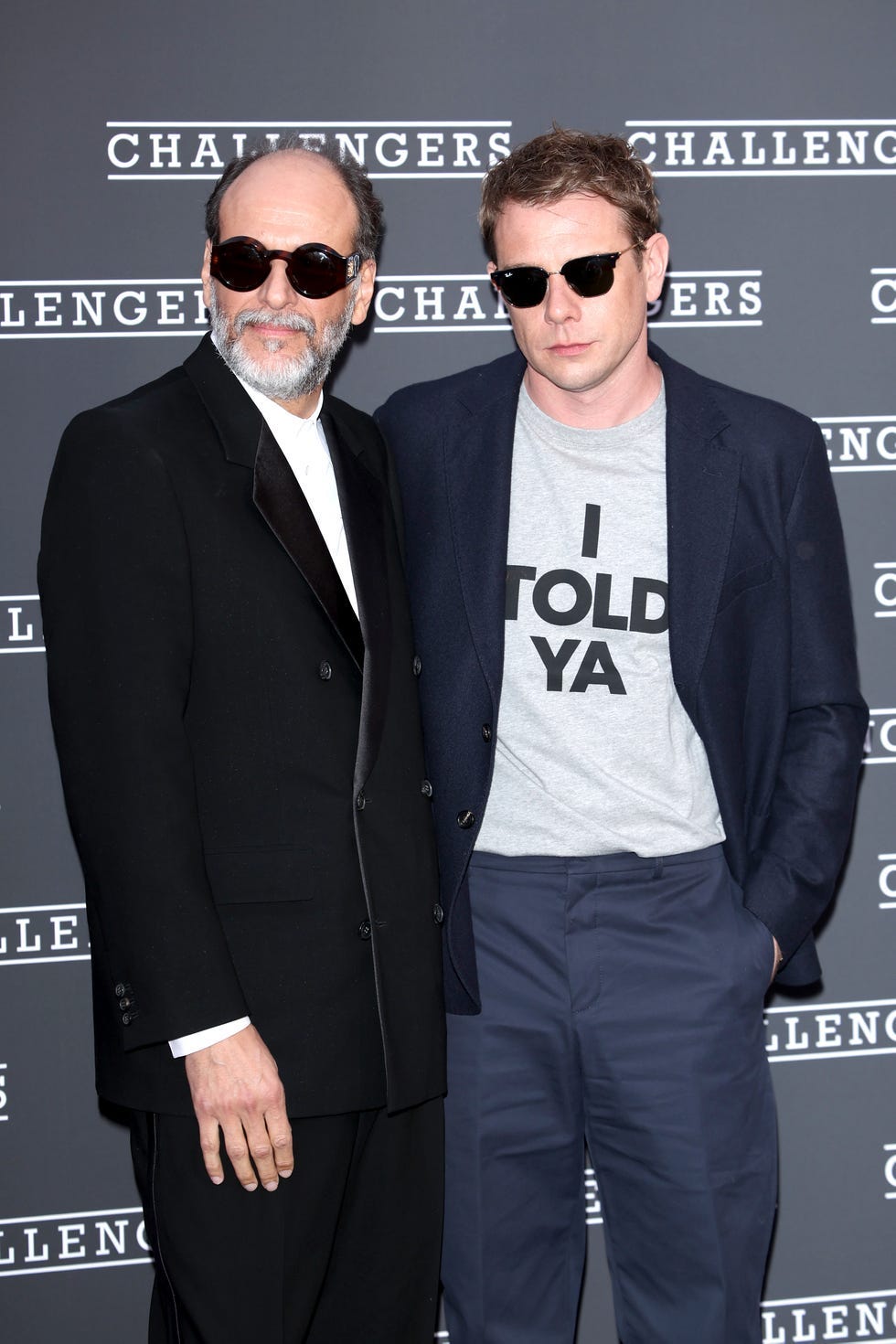
Early on, I notice that in identical seats, a few rows down from us in the audience, are Celine Song and Justin Kuritzkes, the filmmaking power couple: Song, responsible for writing and directing the films Past Lives and The Materialists, and Kuritzkes, responsible for penning Guadagnino’s Challengers and Queer. I have seen them separately at different film events, but never together, and, therefore, never this intimate. I averted my gaze to give them privacy, but throughout the show, I kept wondering what the two of them thought of the show, of Olivia Dean’s proclamations of love. How her performance might rival or reinforce their own depictions of love, popular consumable products in their own right. Within the filmmakers’ work, their portrayal of love can be read as more complex than that of the singer’s, but maybe that has more to do with their chosen medium of filmmaking (a film is longer than an album) than with art’s texture itself. The best pop songs are the simplest, and the yearning of Past Lives and the toxic desire of Queer are just as burning as the themes on Olivia Dean’s album. Briefly, I envision all three of them at a dinner table, a triptych of our reigning custodians of contemporary love; all we were missing was Sally Rooney.
Despite, or maybe as a result of, the success of their artistry, all of their work has been heavily clipped and commoditized into bite-sized, “snackable” products, immortalized through fancams on TikTok, be it vignettes of the hot love triangle from Challengers or the trending sounds of “Man I Need” cut to wedding content. Many of their produced personas, like the polka-dotted imagery of the pop star or the Jonathan Anderson-designed “I TOLD YA” t-shirts of film characters, can be bought and worn — from culture to commodity to costume. The love once displayed in art is mined for its aesthetics, its material output. Love is bought and worn, rather than inhabited.
What does this say about this generation, so bent on experiencing love through surrogacy, obtaining it indirectly through consumable products rather than embodying it themselves? The same generation who streams Dua Lipa’s “Training Season” back into the charts, years after its release, because they believe it’s a manifestation anthem and reads Hernan Diaz’s Trust so they can meet their own Callum Turner? The same generation who enters a crippling psychosis over a fictional gay romance between hockey players that results in real-life stalking, doxing, and violence? Who then uses AI to write fan fiction and throws a tantrum over it? Who believes that Love Island relationships, once they leave the villa, are, in fact, real and not opportunities for brand deals? A generation that follows “looksmaxxing” tutorials from the manosphere to “bonesmash” and improve their perceived “Sexual Market Value?” Who greedily eats grapes under the table at New Year’s Eve as part of a bizarre pagan ritual when the clock strikes midnight, instead of mustering the courage to kiss their crush? Maybe the sheer lack of reason beneath these things isn’t shallow, but what actually makes it romantic. Love is both easy and hard to explain. But it’s easier to buy and wear the polka dots to an Olivia Dean concert than to ask someone out. When you pursue love at all costs, regardless of the cost, you always pay. I don’t know if that makes you more of a lover than a consumer when you’re adding to your cart, instead of adding to your… heart (sorry lol).

When we leave the concert, we notice that the bootleggers have somehow made their way into the Garden, now selling their t-shirts beside the stalls of the official concert merchandise. With polite nods, we sidestep them, failing to decipher what merch was official and what was counterfeit. They all looked the same.
As we maneuver into the city streets, bleeps and ringing fill our ears. The exteriors of the arena have become entirely surrounded by pedicabs, a Trojan fleet all positioned to usher concertgoers into a romantic, summer night. I eye the theatrics of the transportation, interested. Each cab blares an Olivia Dean song of their choosing, creating a cacophony as if multiple people were playing music from their phones at the same time on the subway. The seats of the cabs are decorated with pink cushions and blush boas. Small twinkle lights wink at us as we waltz past. A few ladies in polka dot dresses pose for pictures in the sticky nighttime heat, wedged between a kebab cart and pedicab blasting “Nice to Each Other.”
When we think we are in the clear, a lady waves me down, asking me to take a picture of her and her friends in the midst of the chaos, to which I oblige. I snap a handful, delicately framing her and her friends through the screen of the phone and zooming out to capture the sprawling scene, the nighttime bazaar of love. I glance through the shots before handing it back to her, a repeated object catching my eye across the camera roll. On the edge of each image, a white sign gleams with bold, block letters attached to the pedicab. It reads: “We take Venmo, PayPal, Cash App, but cash is preferred.” We leave the lady smiling at her phone and head off into the night.
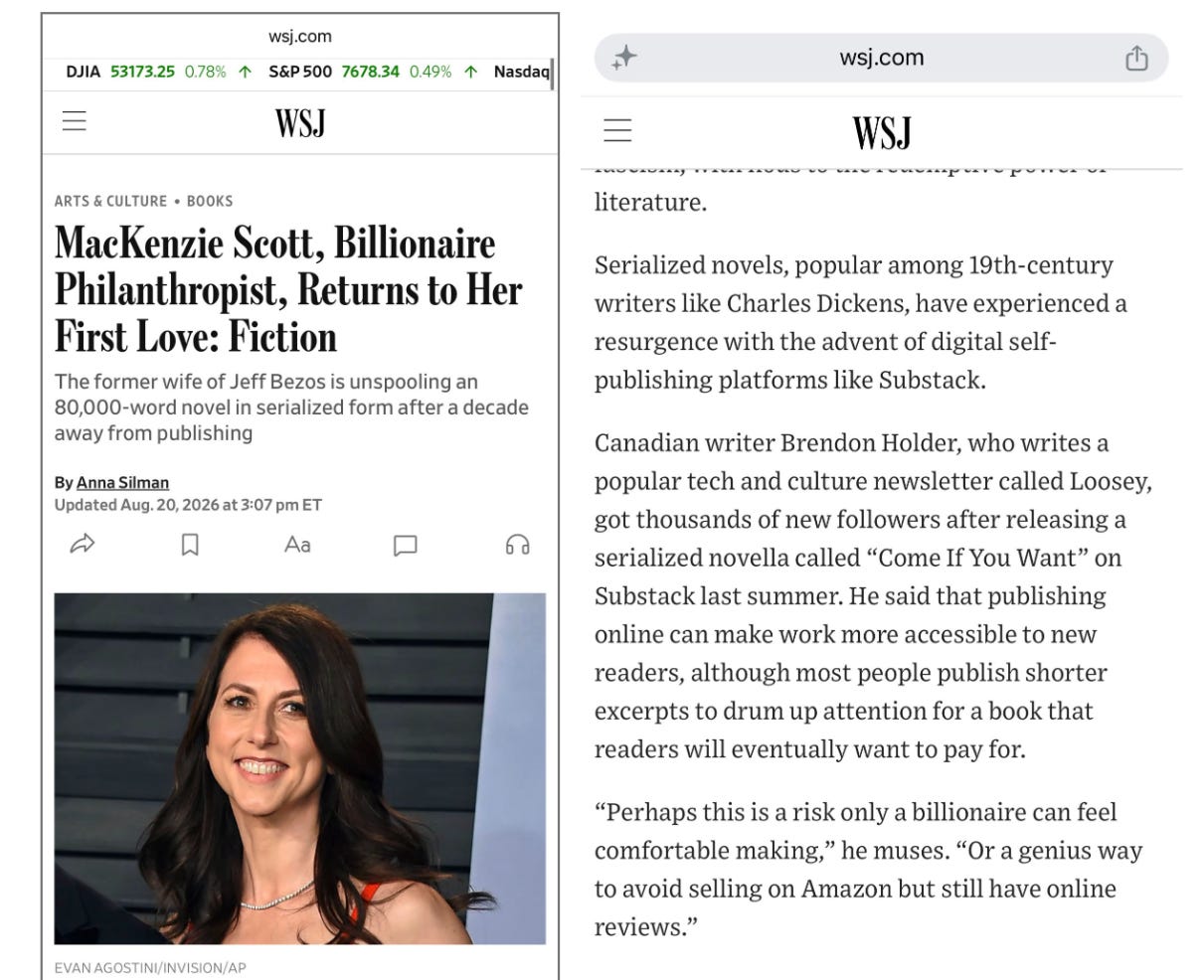
Housekeeping: I’ve been outside! A few days ago, I was interviewed by the Wall Street Journal about fiction on Substack and the serial novella I published last summer. Thank you to the dedicated subscribers who read and shared “Come If You Want” last year. If you’re new, start with Chapter One!
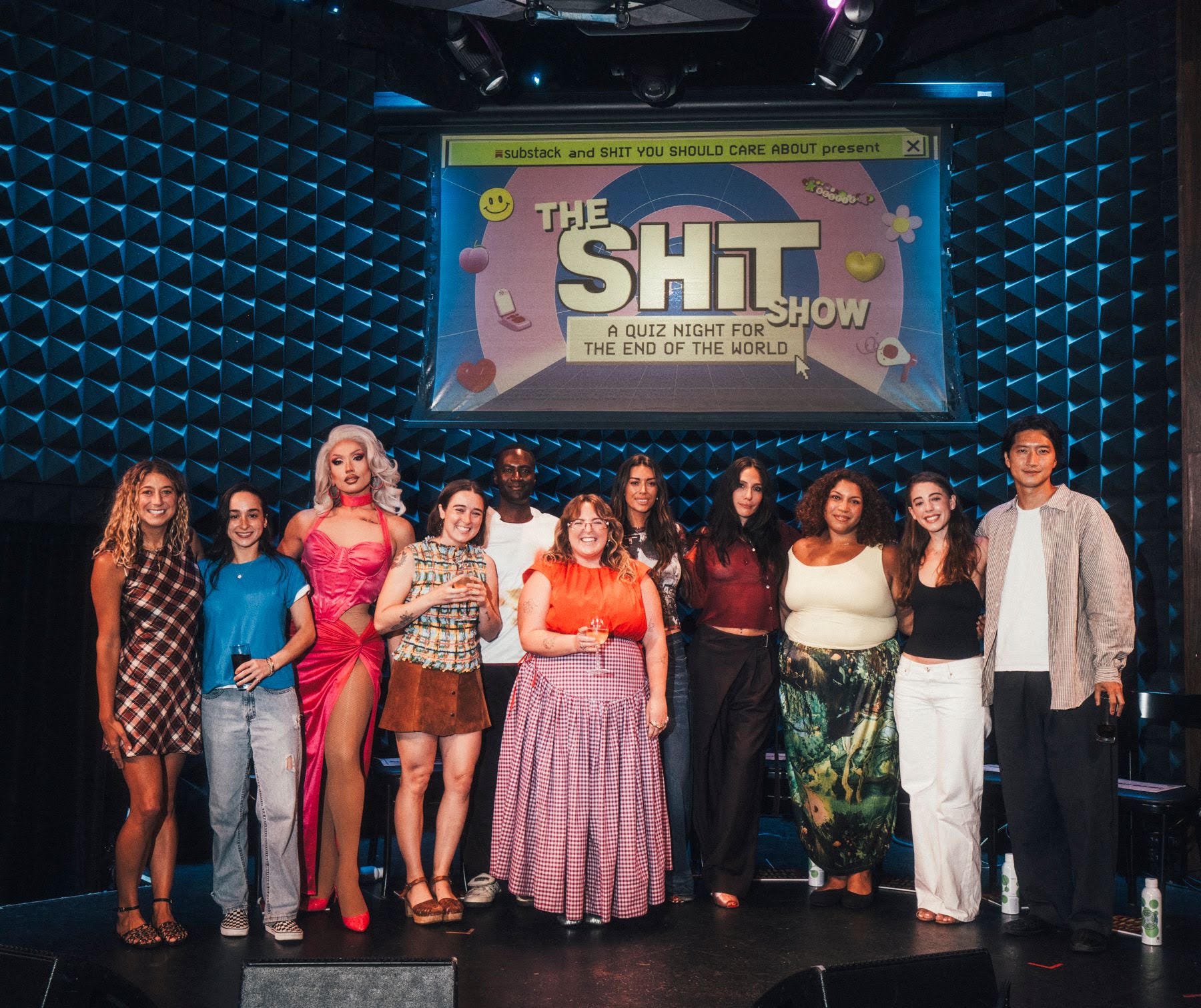
A few weeks prior, I participated in live pop culture trivia at NYC’s Joe’s Pub, hosted by shit you should care about with other writers and personalities, and won. Thank you to everyone who came out, and to Lucy Blakiston and the Substack team for the invitation.
More soon! Thanks for reading.
Other LOOSEY reads…


LOOSEY is a bi-weekly newsletter about culture, technology, and the way we live. If this is something you like, consider subscribing and sharing. Let’s be friends on Instagram.